£94.99
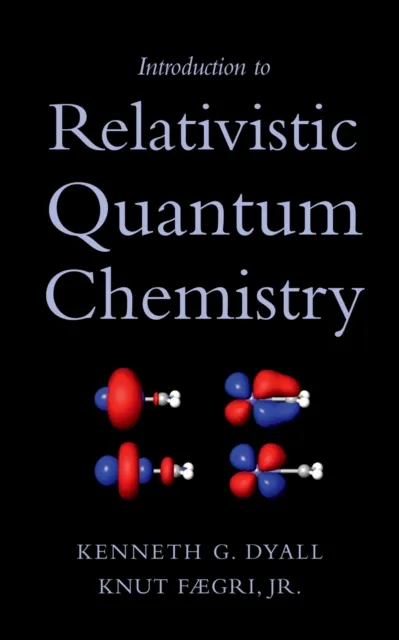
Introduction to Relativistic Quantum Chemistry

Introduction
This book provides an introduction to the essentials of relativistic effects in quantum chemistry, and a reference work that collects all the major developments in this field. It is designed for the graduate student and the computational chemist with a good background in nonrelativistic theory.
In addition to explaining the necessary theory in detail, at a level that the non-expert and the student should readily be able to follow, the book discusses the implementation of the theory and practicalities of its use in calculations.
Classical Relativity and Electromagnetism
After a brief introduction to classical relativity and electromagnetism, the Dirac equation is presented, and its symmetry, atomic solutions, and interpretation are explored.
Four-Component Molecular Methods
Four-component molecular methods are then developed: self-consistent field theory and the use of basis sets, double-group and time-reversal symmetry, correlation methods, molecular properties, and an overview of relativistic density functional theory. The emphases in this section are on the basics of relativistic theory and how relativistic theory differs from nonrelativistic theory.
Approximate Methods
Approximate methods are treated next, starting with spin separation in the Dirac equation, and proceeding to the Foldy-Wouthuysen, Douglas-Kroll, and related transformations, Breit-Pauli and direct perturbation theory, regular approximations, matrix approximations, and pseudopotential and model potential methods.
For each of these approximations, one-electron operators and many-electron methods are developed, spin-free and spin-orbit operators are presented, and the calculation of electric and magnetic properties is discussed.
The treatment of spin-orbit effects with correlation rounds off the presentation of approximate methods.
Conclusion
The book concludes with a discussion of the qualitative changes in the picture of structure and bonding that arise from the inclusion of relativity.