£45.99
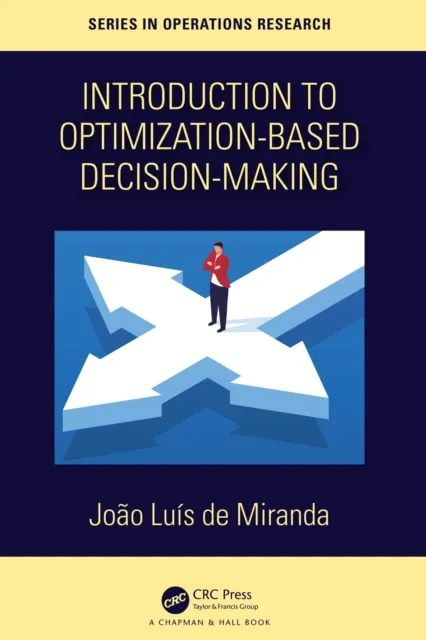
Introduction to Optimization-Based Decision-Making

The large and complex challenges the world is facing, the growing prevalence of huge data sets, and the new and developing ways for addressing them (artificial intelligence, data science, machine learning, etc.), means it is increasingly vital that academics and professionals from across disciplines have a basic understanding of the mathematical underpinnings of effective, optimized decision-making. Without it, decision makers risk being overtaken by those who better understand the models and methods, that can best inform strategic and tactical decisions.
Introduction to Optimization-Based Decision-Making provides an elementary and self-contained introduction to the basic concepts involved in making decisions in an optimization-based environment. The mathematical level of the text is directed to the post-secondary reader, or university students in the initial years. The prerequisites are therefore minimal, and necessary mathematical tools are provided as needed. This lean approach is complemented with a problem-based orientation and a methodology of generalization/reduction. In this way, the book can be useful for students from STEM fields, economics and enterprise sciences, social sciences and humanities, as well as for the general reader interested in multi/trans-disciplinary approaches.
Features
- Collects and discusses the ideas underpinning decision-making through optimization tools in a simple and straightforward manner
- Suitable for an undergraduate course in optimization-based decision-making, or as a supplementary resource for courses in operations research and management science
- Self-contained coverage of traditional and more modern optimization models, while not requiring a previous background in decision theory