£99.50
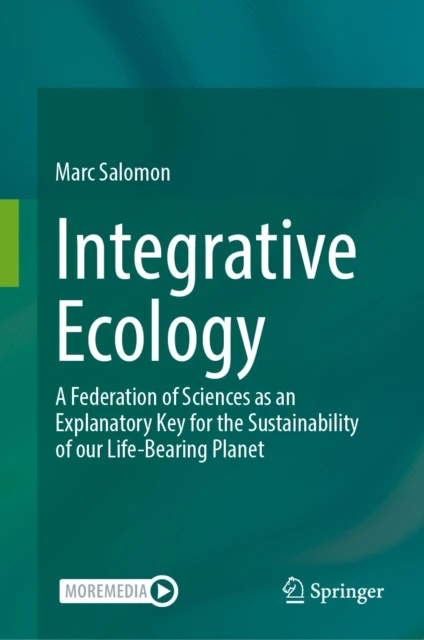
Integrative Ecology
A Federation of Sciences as an Explanatory Key for the Sustainability of our Life-Bearing Planet

Ecology as a Science
Ecology is traditionally presented as a science explaining a highly diverse range of subjects, for example the biogeochemical cycle of oxygen or the structure of species communities. We also tend to incorporate into ecology environmental degradation inflicted by human activities directly or indirectly upon natural systems and the attempts to prevent or mitigate these destructive trends.
While fundamental ecology is a broad scientific discipline dealing with ecosystems through a diverse number of approaches, applied ecology is more a philosophy and body of practices with a focus on society and politics. Applied ecology uses concepts used in fundamental ecology. Although the topics of fundamental ecology appear disconnected, it is often felt that they belong to the same field.
This book will focus predominately on fundamental ecology. It comprises different sections arranged in a logical and linear architecture for the reader to follow. The chapters, though, are neatly interlinked to create an explanatory system reflecting the systemic nature of ecology.
The Scientific Character of Ecology
As even distinguished scientists are uncertain about the scientific character of ecology, it is important to explain rationally why these subjects are all topics of the same discipline, which epistemologically can be proven to be an actual science. As such ecology needs to define its scope and “meta-theory”, a system of interrelated consistent theories uniting many studies regarded empirically as different fields.
History and Development of Ecology
In this regard, this textbook presents an integrative vision of ecology. The history of ecology will also be addressed to explain the development of the field of ecology and its relationship to human activities and ways of thinking since prehistorical time until the present.
Interactions within Ecosystems
In addition, the book presents a typology of the interactions within the biocoenoses, separating trophic relationships from other types of interactions (coevolution, competition, mineralisation), and presents a reflection on the interactions with the abiotic system.
The Systemic View of Ecology
This book shows that ecology must be viewed as an integrated system to explain the immensely complex reality of ecosystems in the simplest way possible.