£109.99
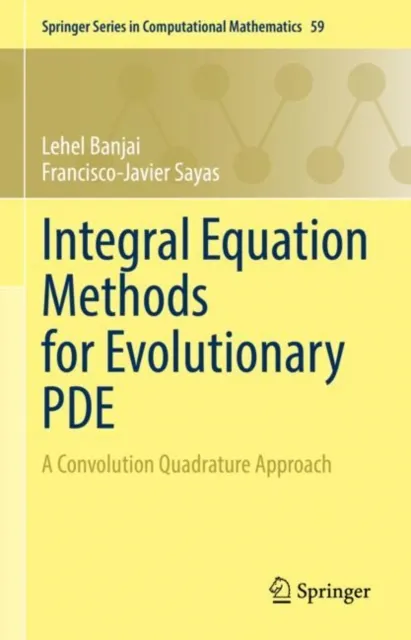
Integral Equation Methods for Evolutionary PDE
A Convolution Quadrature Approach

Book Description
This book provides a comprehensive analysis of time domain boundary integral equations and their discretisation by convolution quadrature and the boundary element method.
Properties and Implementation
Properties of convolution quadrature, based on both linear multistep and Runge–Kutta methods, are explained in detail, always with wave propagation problems in mind. Main algorithms for implementing the discrete schemes are described and illustrated by short Matlab codes; translation to other languages can be found on the accompanying GitHub page. The codes are used to present numerous numerical examples to give the reader a feeling for the qualitative behaviour of the discrete schemes in practice.
Applications
Applications to acoustic and electromagnetic scattering are described with an emphasis on the acoustic case where the fully discrete schemes for sound-soft and sound-hard scattering are developed and analysed in detail. A strength of the book is that more advanced applications such as linear and non-linear impedance boundary conditions and FEM/BEM coupling are also covered. While the focus is on wave scattering, a chapter on parabolic problems is included which also covers the relevant fast and oblivious algorithms. Finally, a brief description of data sparse techniques and modified convolution quadrature methods completes the book.
Intended Audience
Suitable for graduate students and above, this book is essentially self-contained, with background in mathematical analysis listed in the appendix along with other useful facts. Although not strictly necessary, some familiarity with boundary integral equations for steady state problems is desirable.