£56.99
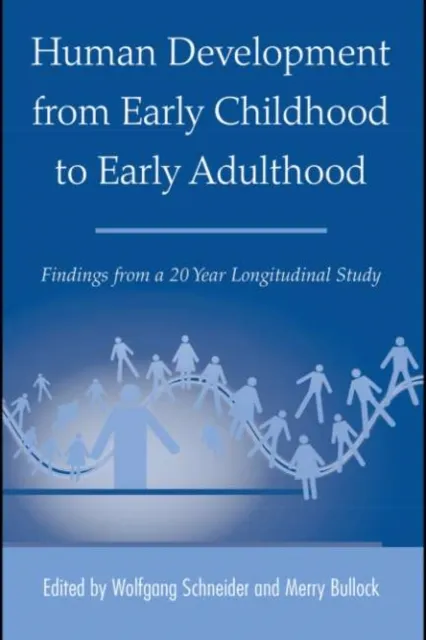
Human Development from Early Childhood to Early Adulthood
Findings from a 20 Year Longitudinal Study

Data and Study Overview
Data generated from longitudinal studies allow researchers to better understand how context and experience interact with stable characteristics of the developing person over time. This book summarizes a landmark longitudinal study of 200 children, from the ages of 3 to 23. The Munich Longitudinal Study on the Ontogenesis of Individual Competencies (LOGIC) examined the development of individual differences over time and whether it is possible to predict later competencies from earlier ones. Offering a snapshot of theory and data on personality, social, motor, moral, and cognitive development, the contributors help us understand which individual differences can and cannot be altered through schooling and other experiences and how differences seen in the earliest stages are later reflected in adulthood. The results provide valuable insight into the strengths and limitations of early prediction of individual differences.
Volume and Continuation of Research
This is the second volume to review the wealth of data generated by the study. The first volume (Weinert and Schneider, 1999) traced development from ages 3 to 12. This volume continues the story, integrating these early findings with the results from adolescence and young adulthood.
Research Findings
Each of the chapters provides an overview of current research and addresses how the data help us understand the presence and developmental effects of individual differences. Among the findings are results on:
- The relative stability of cognitive competencies
- The long term effects of shyness and aggression
- The relation between moral understanding and action, and
- The role of education in the development or maintenance of performance differences.
Target Audience
Intended for researchers and advanced students in developmental, educational, personality, social, and cognitive psychology, this book will also appeal to educators, especially the chapters that focus on literacy development, educational context, scientific reasoning and mathematical reasoning.