£38.00
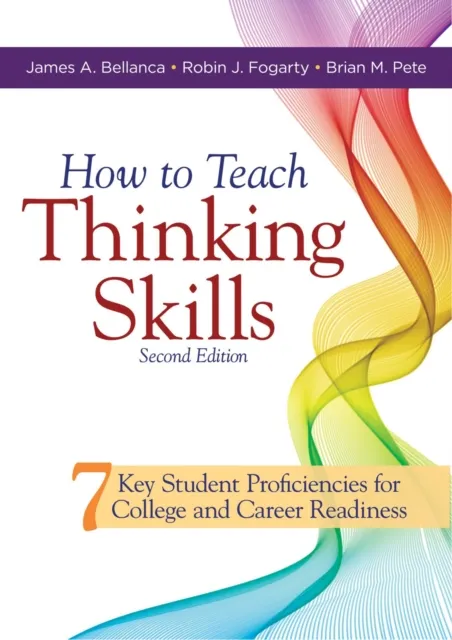
How to Teach Thinking Skills
Seven Key Student Proficiencies for College and Career Readiness (Teaching Thinking Skills for Student Success in a 21st Century World)

Ensure your students develop the complex, higher-order thinking skills they need to not just survive but thrive in a 21st century world. The latest edition of this best-selling guide by James A. Bellanca, Robin J. Fogarty, and Brian M. Pete details a three-phase teaching model and dives deep into how to teach seven key student proficiencies: critical thinking, creative thinking, complex thinking, comprehensive thinking, collaborative thinking, communicative thinking, and cognitive transfer.
How to teach higher-order thinking skills for student engagement and achievement:
Receive guidance on teaching higher-order thinking skills according to any given standard, including state standards and content-area standards.
Learn how to weave thinking skills and technology into your existing teaching strategies and lesson plans.
Understand how to adapt lessons for various grade levels and subjects.
Gain questions to reflect on after lessons, to ensure that students learn at the highest levels and grow their problem solving and innovative thinking.
Attain tools and reproducibles to facilitate learning and understanding of teaching critical thinking and other 21st century skills.
Contents:
Acknowledgments
Table of Contents
About the Authors
Introduction
Student Proficiency 1: Critical Thinking
Chapter 1: Analyze
Chapter 2: Evaluate
Chapter 3: Problem Solve
Student Proficiency 2: Creative Thinking
Chapter 4: Generate
Chapter 5: Associate
Chapter 6: Hypothesize
Student Proficiency 3: Complex Thinking
Chapter 7: Clarify
Chapter 8: Interpret
Chapter 9: Determine
Student Proficiency 4: Comprehensive Thinking
Chapter 10: Understand
Chapter 11: Infer
Chapter 12: Compare and Contrast
Student Proficiency 5: Collaborative Thinking
Chapter 13: Explain
Chapter 14: Develop
Chapter 15: Decide
Student Proficiency 6: Communicative Thinking
Chapter 16: Reason
Chapter 17: Connect
Chapter 18: Represent
Student Proficiency 7: Cognitive Transfer
Chapter 19: Synthesize
Chapter 20: Generalize
Chapter 21: Apply
Appendix A
Appendix B
Appendix C
Appendix D
Glossary
References & Resources
Index