£58.99
History of Universities
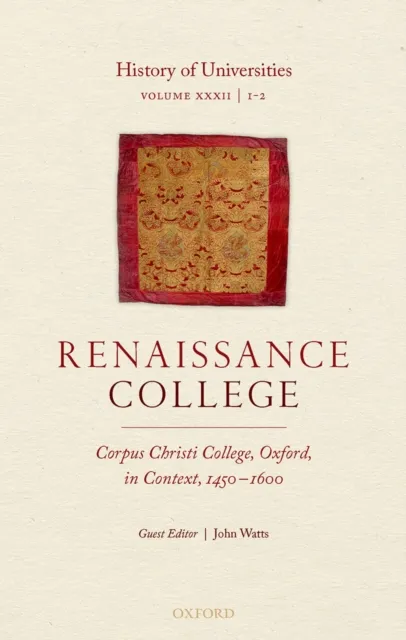
Volume XXXII / 1-2: Renaissance College: Corpus Christi College, Oxford, in Context, 1450-1600

Introduction
This issue of History of Universities, Volume XXXII / 1-2, contains the customary mix of learned articles and book reviews which makes this publication such an indispensable tool for the historian of higher education. Guest edited by Professor John Watts, this volume focuses on the history of Corpus Christi College, Oxford.
History of Corpus Christi College
Corpus Christi College, Oxford was founded in 1517 to advance humanistic learning in the service of God. This collection of essays by some of the leading historians of late medieval and early modern England takes the early history of the College as a starting point to explore the intellectual, social, religious, political, and cultural trends of the era of Renaissance and Reformation.
Scope of the Essays
Ranging from the fifteenth century to the seventeenth, and taking in the study of Greek and Hebrew; the practices of antiquarianism, charity, and divine worship; the experience of music, punishment, and the built environment; the networks that connected the college to London and the government; and the interactions of scholars with royal policy on religion, these fifteen essays and three commentaries aim to expose the multiple perspectives from which an early modern college can be viewed and understood.
The Central Themes
The relationship between Renaissance and Reformation, and the social and cultural realities that accompanied these familiar concepts, form one central theme in the papers; the relationship between religious or educational institutions and the state form another. Corpus Christi itself emerges as less innovative than its historic reputation as the first collegium trilingue might suggest, but it becomes the gateway to a richer appreciation of the overlapping worlds of learning, religion, and public life in a time of rapid change.