£139.50
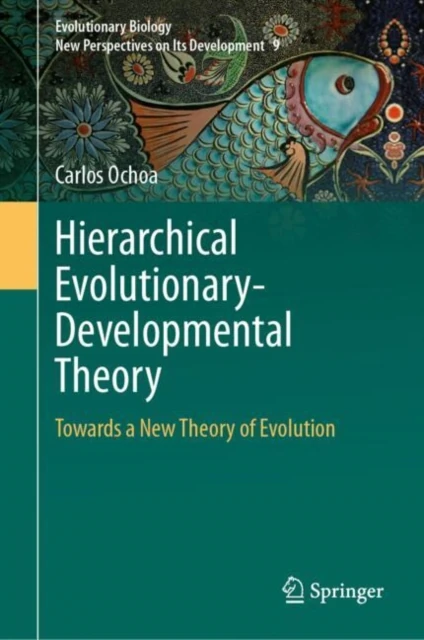
Hierarchical Evolutionary-Developmental Theory
Towards a New Theory of Evolution

Introduction to the Theory
This book introduces a new evolutionary model called “Hierarchical Evolutionary-Developmental Theory” or “H-Evo-Devo Theory.” This theory proposes that the organism’s internal properties reflect entities that are highly integrated in developmental terms that evolve hierarchically. In other words, it attempts to demonstrate that developmental constraints operate at different scales, producing distinct states of morphological stability reflected as subspecies, species, higher taxa, and homologues, all representing units of evolution. In addition, it reintroduces the concept of the “organism” in evolutionary biology, supports a strictly macroevolutionary view, and contemplates alternative evolutionary rates, processes, and mechanisms at different levels: microevolution, macroevolution, megaevolution, and modular-evolution. In short, this book establishes a new synthesis between systematics, morphology, and evolution, suggesting a significant shift in evolutionary thought.
The Contents of the Book
The book comprises:
1. A proposal for a new theory of evolution and systematics: The H-Evo-Devo Theory reinterprets the concepts of subspecies, species, higher taxa, and homologues, proposing that the phylogenetic tree is built on a hierarchy of types, developed from the top-down, in contrast to the traditional bottom-up approach.
2. A novel hierarchical perspective that reveals the underlying mechanisms acting on the patterns of divergence, stability, and extinction of the units of evolution.
3. A resolution to the ontological problem regarding units of evolution (e.g., the reality of species and higher taxa).
4. A historical narrative that focuses on the development of a hierarchy theory of evolution grounded in the type concept and the significance of an organism-centered perspective.
5. A challenge to traditional frameworks that have sought to establish hierarchies in an evolutionary context.
6. A challenge to classical evolutionary statements such as gradualism, punctuated equilibrium, the extrapolationist premise, and geographical models of speciation.
Intended Audience
This book is written for those who feel that radical change is needed in evolutionary theory, offering them a viable alternative.