£32.89
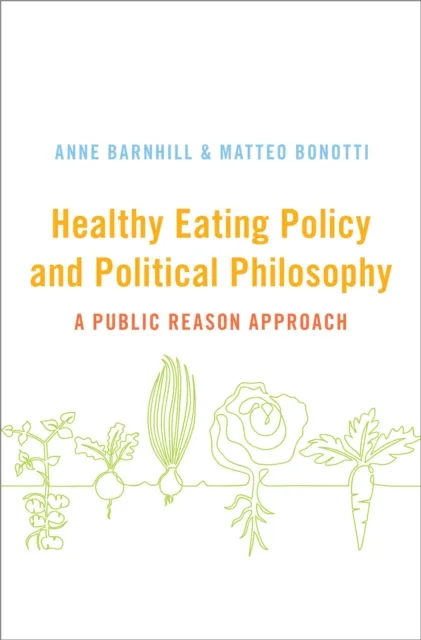
Healthy Eating Policy and Political Philosophy
A Public Reason Approach

Introduction
Who gets to decide what it means to live a healthy lifestyle, and how important a healthy lifestyle is to a good life? As more governments make preventing obesity and diet-related illness a priority, it has become more important to consider the ethics and acceptability of their efforts.
Controversies in Healthy Eating Policies
When it comes to laws and policies that promote healthy eating--such as special taxes on sugary drinks and the banning of food deemed unhealthy--critics argue that these policies are paternalistic, and that they limit individual autonomy over food choices.
About the Book
In Healthy Eating Policy and Political Philosophy: A Public Reason Approach, Anne Barnhill and Matteo Bonotti show that both paternalistic justifications for healthy eating efforts and anti-paternalistic arguments against them can be grounded in perfectionist views that overly prioritize some values over others.
The authors therefore propose a more inclusive, public reason approach to healthy eating policy that will be appealing to those who take pluralism and cultural diversity seriously, by providing a framework through which different kinds of values, including but not limited to autonomy and health, can be factored into the public justification for healthy eating efforts.
Additionally, the book adopts a farm to fork approach to the ethics of healthy eating efforts: it engages with theories and debates in political philosophy, considers the implications of different theoretical positions for healthy eating efforts, and then develops a concrete tool for assessing policies that will be of interest to both scholars and policymakers.
As well as offering a novel normative analysis of healthy eating policy, the authors offer a new theoretical framework that will be applicable to a wide range of public policy scenarios.