£44.99
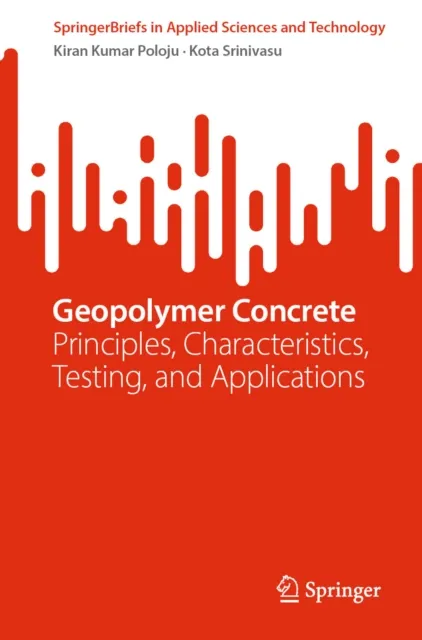
Geopolymer Concrete
Principles, Characteristics, Testing, and Applications

Introduction to Geopolymer Concrete
This book discusses geopolymer concrete, an innovative and sustainable alternative to traditional Portland cement concrete. Geopolymer concrete is synthesized through the chemical reaction between industrial byproducts, such as fly ash or blast furnace slag, and alkaline activators. It offers environmental sustainability by utilizing industrial waste materials as its main components, reducing carbon footprint and resource depletion.
Production and Environmental Benefits
The production process of geopolymer concrete further contributes to its eco-friendly profile as it can be cured at ambient temperatures or with minimal heat input, significantly lowering energy consumption and greenhouse gas emissions. The chemistry of geopolymer involves the dissolution of aluminosilicate materials in a highly alkaline environment, followed by the condensation and reorganization of silica and alumina species to form a three-dimensional network structure.
Research Significance
The research on geopolymer concrete is important for several reasons. First, it provides a sustainable alternative to traditional Portland cement concrete, which has significant environmental impacts due to its high carbon dioxide emissions, resource depletion, and energy consumption. Second, geopolymer concrete offers enhanced durability and resistance to chemical attacks, making it a suitable material for various construction applications. Lastly, the use of industrial byproducts in geopolymer concrete production reduces waste and conserves natural resources, promoting circular economy principles in the construction industry.