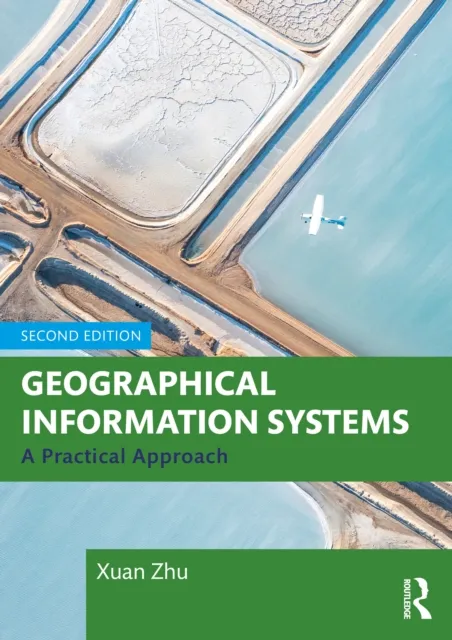
£35.99
Geographical Information Systems
A Practical Approach

Introduction
Geographical information systems (GIS) are powerful tools for reporting on the environment, natural resources and social and economic development; modelling the environmental, biophysical, social and economic processes; assessing environmental and social impacts; evaluating environmental, social and economic policies and actions and dissimilating spatial information. Geographical Information Systems: A Practical Approach provides the fullest available introduction to GIS and their environmental, social and economic applications. This new edition has been substantially revised and updated to incorporate the key developments in GIS technology and spatial data science and their applications that have taken place in recent years.
Key Features
The key features include:
- A comprehensive coverage of concepts, methods, techniques and tools in GIS for spatial data capturing, processing, visualisation, analysis, modelling and decision-making
- Incorporation of advanced machine learning techniques for spatial data analysis and modelling
- Extended coverage of spatial visualisation with 3D mapping and online mapping
- Weaving together of GIS theory and practice to help readers learn important GIS concepts and methods and develop their understanding through practicals with ArcGIS Pro or QGIS
- New and updated case studies illustrating the innovative use of GIS for a wide range of applications
Conclusion
The second edition of this text continues to bring up-to-date GIS knowledge, tools and practices into one cohesive, comprehensive, concise and self-contained book which is accessible to students, scientists and practitioners in environmental science, earth science, geography, archaeology and other scientific studies that have a spatial dimension.