£129.99
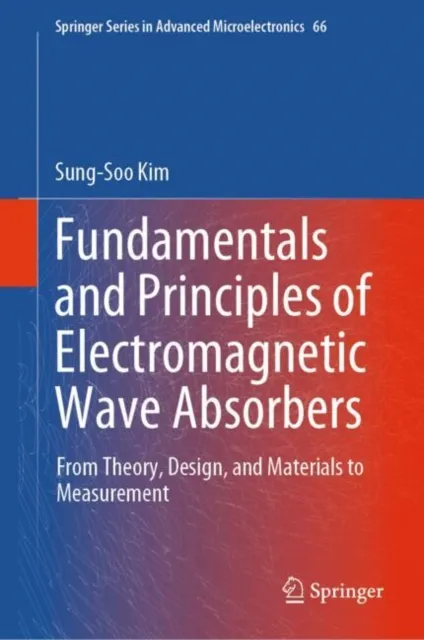
Fundamentals and Principles of Electromagnetic Wave Absorbers
From Theory, Design, and Materials to Measurement

Part 1: Fundamental Theory
This book consists of three main parts: fundamental theory, design principles and methodology, and potential materials that can be applied to EM wave absorbers. In the theory part, this book provides the basics of electromagnetism, circuit and transmission line theory, EM wave propagation and reflection, and complex permittivity and permeability by electric polarization and magnetization of materials.
Part 2: Design Principles and Methodology
In the design part, design methods are explained for various types of EM wave absorbers based on equivalent circuit models and simulation technologies. Starting from the traditional resonance-type absorber, this book reviews the latest metamaterial and frequency selection surface (FSS) absorbers with more advanced design techniques. Recent research results are also included associated with how to design the ultrawide-bandwidth absorbers through multilayering FSSs or shape-control of lossy materials.
Part 3: Potential Materials
In the materials section, various lossy materials are reviewed that can be used as EM wave absorbers, including conductive materials, magnetic materials, dielectric materials, core-shell materials, fiber-reinforced composite materials, and metamaterials or metasurfaces. Literature reviews on their electromagnetic properties and EM wave absorption performance are also presented. Finally, the methods and principles for measuring the high-frequency properties (complex permittivity and permeability) and EM wave absorption are described.