£44.99
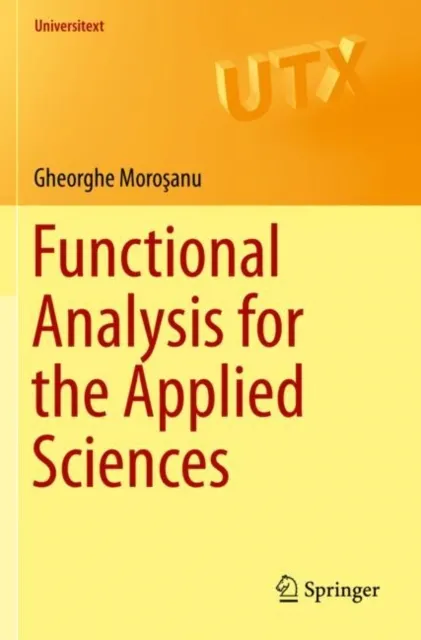
Functional Analysis Tools for Practical Use in Sciences and Engineering

Book Description
This textbook describes selected topics in functional analysis as powerful tools of immediate use in many fields within applied mathematics, physics and engineering. It follows a very reader-friendly structure, with the presentation and the level of exposition especially tailored to those who need functional analysis but don’t have a strong background in this branch of mathematics. For every tool, this work emphasizes the motivation, the justification for the choices made, and the right way to employ the techniques. Proofs appear only when necessary for the safe use of the results.
Structure and Content
The book gently starts with a road map to guide reading. A subsequent chapter recalls definitions and notation for abstract spaces and some function spaces, while Chapter 3 enters dual spaces. Tools from Chapters 2 and 3 find use in Chapter 4, which introduces distributions. The Linear Functional Analysis basic triplet makes up Chapter 5, followed by Chapter 6, which introduces the concept of compactness. Chapter 7 brings a generalization of the concept of derivative for functions defined in normed spaces, while Chapter 8 discusses basic results about Hilbert spaces that are paramount to numerical approximations. The last chapter brings remarks to recent bibliographical items. Elementary examples included throughout the chapters foster understanding and self-study.
Target Audience
By making key, complex topics more accessible, this book serves as a valuable resource for researchers, students, and practitioners alike that need to rely on solid functional analysis but don’t need to delve deep into the underlying theory.