£187.95
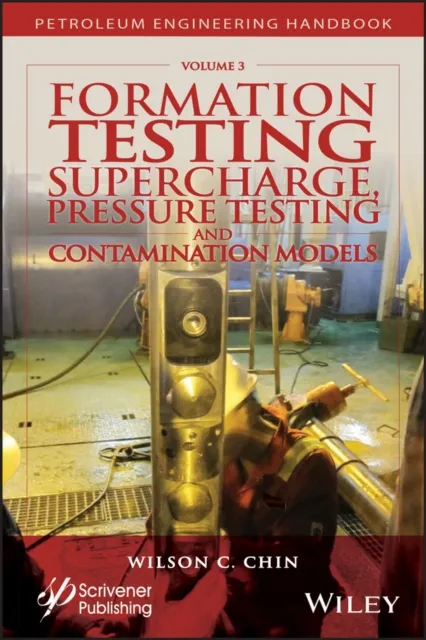
Formation Testing
Supercharge, Pressure Testing, and Contamination Models

Overview
This new volume, the third in Wiley-Scrivener's series on formation testing, reviews pressure transient interpretation and contamination analysis methods, providing numerous practical discussions and examples with rigorous formulations solved through exact, closed form, analytical solutions.
Development and Industry Impact
This new volume in the "Formation Testing" series further develops new methods and processes that are being developed in the oil and gas industry. In the 1990s through 2000s, the author co-developed Halliburton's commercially successful GeoTapTM real-time LWD/MWD method for formation testing, and also a parallel method used by China Oilfield Services, which enabled the use of data taken at early times, in low mobility and large flowline volume environments, to support the important estimation of mobility, compressibility and pore pressure, which are necessary for flow economics and fluid contact boundaries analyses (This work was later extended through two Department of Energy Small Business Innovation Research awards.).
Addressing High-Pressure Challenges
While extremely significant, the effect of high pressures in the borehole could not be fully accounted for. The formation tester measures a combination of reservoir and mud pressure and cannot ascertain how much is attributed to unimportant borehole effects. The usual approach is "simply wait" until the effects dissipate, which may require hours, which imply high drilling and logging costs, plus increased risks in safety and tool loss. The author has now modeled this "supercharge" effect and developed a powerful mathematical algorithm that fully accounts for mud interactions. In short, accurate predictions for mobility, compressibility and pore pressure can now be undertaken immediately after an interval is drilled without waiting.
Conclusion
This groundbreaking new work is a must-have for any petroleum, reservoir, or mud engineer working in the industry, solving day-to-day problems that he or she encounters in the field.