£49.99
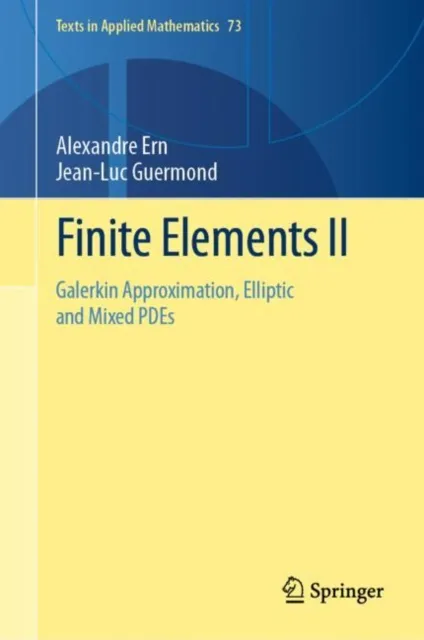
Finite Elements II
Galerkin Approximation, Elliptic and Mixed PDEs

Book Overview
This book is the second volume of a three-part textbook suitable for graduate coursework, professional engineering and academic research. It is also appropriate for graduate flipped classes. Each volume is divided into short chapters. Each chapter can be covered in one teaching unit and includes exercises as well as solutions available from a dedicated website. The salient ideas can be addressed during lecture, with the rest of the content assigned as reading material. To engage the reader, the text combines examples, basic ideas, rigorous proofs, and pointers to the literature to enhance scientific literacy.
Volume Structure and Content
Volume II is divided into 32 chapters plus one appendix. The first part of the volume focuses on the approximation of elliptic and mixed PDEs, beginning with fundamental results on well-posed weak formulations and their approximation by the Galerkin method. The material covered includes key results such as the BNB theorem based on inf-sup conditions, Céa's and Strang's lemmas, and the duality argument by Aubin and Nitsche. Important implementation aspects regarding quadratures, linear algebra, and assembling are also covered. The remainder of Volume II focuses on PDEs where a coercivity property is available. It investigates conforming and nonconforming approximation techniques (Galerkin, boundary penalty, Crouzeix—Raviart, discontinuous Galerkin, hybrid high-order methods). These techniques are applied to elliptic PDEs (diffusion, elasticity, the Helmholtz problem, Maxwell's equations), eigenvalue problems for elliptic PDEs, and PDEs in mixed form (Darcy and Stokes flows). Finally, the appendix addresses fundamental results on the surjectivity, bijectivity, and coercivity of linear operators in Banach spaces.