£3.99
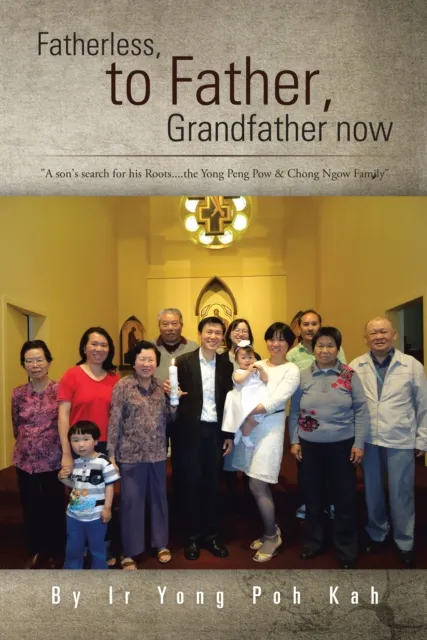
Fatherless, to Father, Grandfather Now
A Son's Search for His Roots....The Yong Peng Pow & Chong Ngow Family

The Author's Roots
The author seeks to trace his roots from the time the grandfather, Yong Koon (Seong) (born in 1871, China; came to British Malaya in 1885 to join his two brothers to work as tinsmiths in Kuala Lumpur). Yong Koon went back to China to seek a wife; married Loh Pat but left when she was with child in 1905. In 1911, he went to China to bring back his wife and first born son, Peng Pow, the father of the author. Another three sons were born: Peng Sin (1914), Peng Kai (1915), and Peng Seong (1923). Initially, Yong Koon and his family stayed with his brothers and their families at their shop at Cross Street, Kuala Lumpur. Later, the grandmother, a shrewd and frugal business lady, saved enough to buy a two-storey shop house at 219 Pudu Road, which the whole family moved to.
Education and Early Business
Peng Pow was a good student who studied in MBSKL in the early years but transferred to Kajang High School where he sat for his Junior Cambridge Exams in 1922. Based on his good scores, he and another classmate, Justice Tan Sri Datok Yong Shi Meow, were asked by the school to sit for the Queen's Scholarship exams in 1924. Both were successful and offered scholarships to study in the United Kingdom, but they had to buy their own steamboat tickets to the UK. Unfortunately, PP's parents refused to give him the money for the ticket as they expected him, being the first-born son and out of filial piety, to stay behind to look after the parents and his three younger brothers. Instead, the parents gave him money to start an English language bookstore in a small room at the corner pawnshop along Yap Ah Loy Street.
Phoenix Bookstore catered mainly to English businessmen, planters, and returning soldiers serving in British Malaya then. By accident, an English businessman, aware that PP's father and uncles were tinsmiths, suggested that he should experiment with the manufacture of pewter ware such as beer mugs, cigarette cases, candle holders, vases, etc., for export to England and Europe where these were in demand and expensive. After successfully producing some prototype samples, orders poured in, and Malayan Pewter Works, which PP started, moved to 219.
Family and Business Expansion
By then, PP was already married to his child bride (bought into the Yong family in 1917) and had four older children: Woon Yin, Poh Seong, Siew Yin, and Poh Fah. With the assistance of his three younger brothers, the business picked up, and PP even paid for the weddings of the two older children. However, sometime in 1935, PP took a second wife, and in 1939, he told his father and brothers that he was moving to a bigger premises at 4th Mile Cheras Road as his family was increasing and business expanding. After a heated argument with his father and brothers (Loh Pat already deceased), PP and his two wives and twelve children were asked to vacate the patriarch's home of Yong Koon, just after the full moon of the author.
World War II and Personal Tragedy
Not long after, Japan attacked Malaya on 10 December 1941 and occupied Malaya and Singapore on 15 February 1942. Tragically, PP was murdered about six months before Japan surrendered after the dropping of the two atomic bombs on Hiroshima and Nagasaki on 6th and 8th August 1945. The author's mother, a widow with nine fatherless children, was totally devastated, penniless, and distraught. Through sheer endurance, tremendous hardships, sacrifices, and deprivations, she finally saw her second last child (the author) graduate as an engineer in 1966, supported by scholarships in school and university.