£55.99
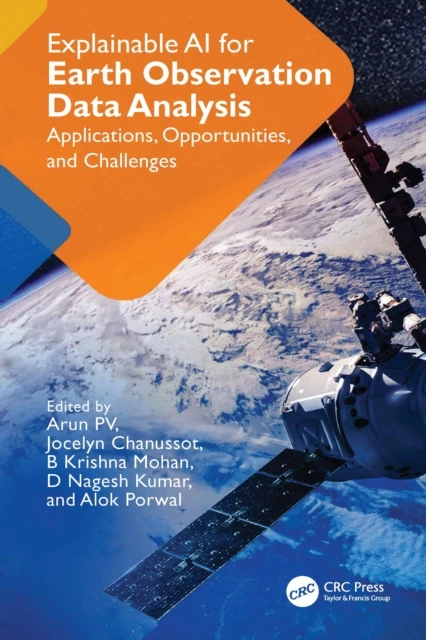
Explainable AI for Earth Observation Data Analysis
Applications, Opportunities, and Challenges

The role of artificial intelligence in Earth Observation data analysis
The role of artificial intelligence is crucial in the domain of Earth Observation (EO) data analysis. Deep learning-based approaches have improved accuracy, but they have affected the reliability and transparency of EO data. It is critical to improve the explainability of EO data analysis algorithms and complex deep learning models to ensure the quality of spatial decisions.
Content overview
This book discusses the various advancements in Explainable AI and investigates their suitability for various EO data analyses offering best practices for implementing algorithms that facilitate big and efficient data processing. It lays the foundation of Explainable EO and helps readers build trustworthy, secure, and robust EO systems.
Features
Examines explainability of algorithms from the aspect of generalizability and reliability
Reviews state-of-the-art explainability strategies related to the preprocessing algorithms
Provides explanations for specific evaluation metrics of various EO data processing and preprocessing algorithms
Discusses explainable ante-hoc and post-hoc approaches for EO data analysis
Serves as a foundational reference for developing future EO data processing strategies
Addresses key challenges in making EO data processing algorithms interpretable and offers insights for the future of explainable EO data processing
Intended audience
This book is intended for graduate students, researchers and academics in computer and data science, machine learning, and image processing, as well as professionals in geospatial data science using GIS and remote sensing in Earth and environmental sciences.