£54.99
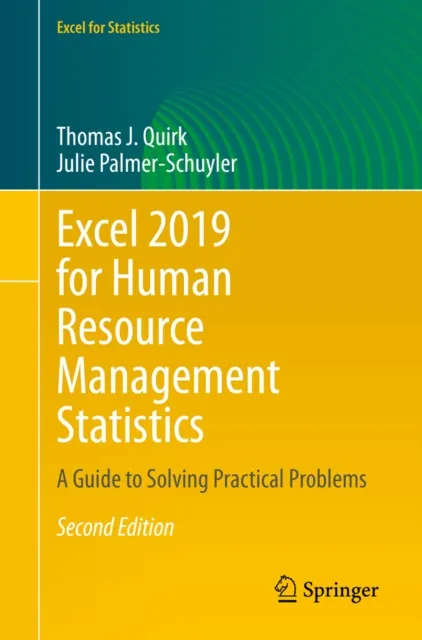
Excel 2019 for Human Resource Management Statistics
A Guide to Solving Practical Problems

Book Overview
This book shows the capabilities of Microsoft Excel in teaching human resource management statistics effectively. Similar to the previously published Excel 2016 for Human Resource Management Statistics, this book is a step-by-step, exercise-driven guide for students and practitioners who need to master Excel to solve practical human resource management problems. If understanding statistics isn’t your strongest suit, you are not especially mathematically inclined, or if you are wary of computers, this is the right book for you.
Excel as a Teaching Tool
Excel, a widely available computer program for students and managers, is also an effective teaching and learning tool for quantitative analyses in human resource management courses. Its powerful computational ability and graphical functions make learning statistics much easier than in years past. However, Excel 2019 for Human Resource Management Statistics: A Guide to Solving Practical Problems, 2nd Edition, capitalizes on these improvements by teaching students and managers how to apply Excel to statistical techniques necessary in their courses and work.
Chapter Content and Practice
Each chapter explains statistical formulas and directs the reader to use Excel commands to solve specific, easy-to-understand human resource management problems. Practice problems are provided at the end of each chapter with their solutions in an appendix. Separately, there is a full practice test (with answers in an appendix) that allows readers to test what they have learned.