£89.50
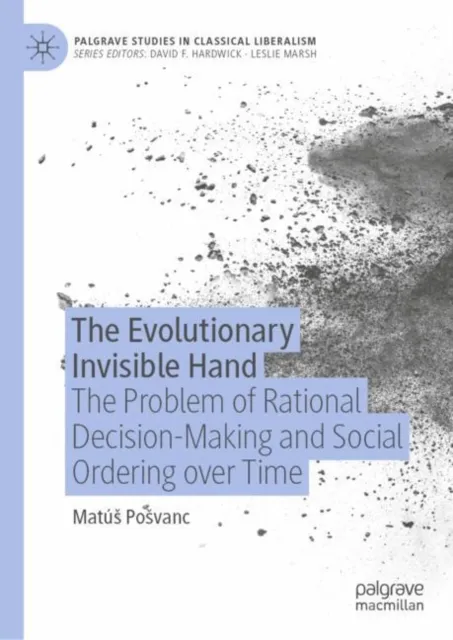
Evolutionary Invisible Hand
The Problem of Rational Decision-Making and Social Ordering over Time

Introduction
The book presents a new theoretical approach to the description of economic phenomena over time. A realistic and meaningful description of economic phenomena over time is one of the basic preconditions for the success of any economic theory. The presented theoretical solution or proposal has two main characteristics. The first is a modification of the theory of subjective value in the form of the claim that one perceives the satisfaction of one''s needs in the context of one''s overall individual portfolio of goods. The causal relationship of the “old” theory in the form of “need is satisfied by good” is modified in terms of “sum of needs is satisfied by portfolio of goods (sum of goods)”. This is a small modification, which, however, brings several important elements to the description of economic phenomena over time. The old theoretical approach did not enable us to operate over time because of different value context of goods which is changing over time. However, the portfolio of goods is, in fact, a formally-logical homogeneous construction of the mind, which is applicable over time. The second characteristic is the anchoring of this modification of the theory of subjective value in evolutionary (intersubjective) apriorism.
Target Audience
The book will be of interest to any Austrian and Mainstream Economists who deal with problems of description of economic phenomena in time. Also, for those involved in topics such as estimating of future, why entrepreneurs are successful or the problem of social ordering or equilibration and those who are interested in the new evolutionary approach to the emergence of criteria for rational decision-making.