£34.99
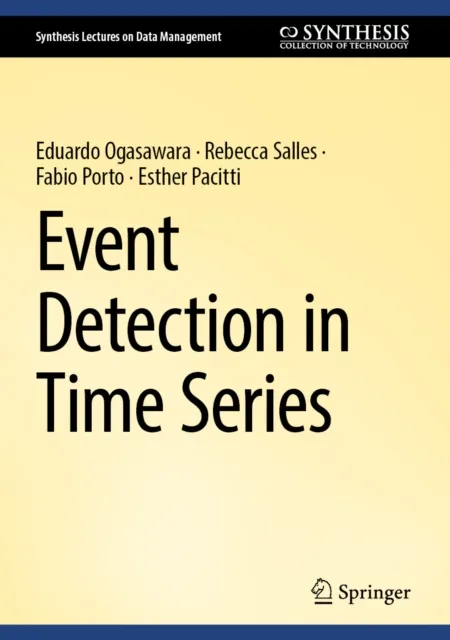
Event Detection in Time Series

Introduction
This book is dedicated to exploring and explaining time series event detection in databases. The focus is on events, which are pervasive in time series applications where significant changes in behavior are observed at specific points or time intervals. Event detection is a basic function in surveillance and monitoring systems and has been extensively explored over the years, but this book provides a unified overview of the major types of time series events with which researchers should be familiar: anomalies, change points, and motifs.
Concepts and Taxonomy
The book starts with basic concepts of time series and presents a general taxonomy for event detection. This taxonomy includes:
- Granularity of events (punctual, contextual, and collective)
- General strategies (regression, classification, clustering, model-based)
- Methods (theory-driven, data-driven)
- Machine learning processing (supervised, semi-supervised, unsupervised)
- Data management (ETL process)
Event Types and Chapters
This taxonomy is woven throughout chapters dedicated to specific event types: anomaly detection, change-point, and motif discovery. The book discusses state-of-the-art metric evaluations for event detection methods and also provides a dedicated chapter on online event detection, including the challenges and general approaches (static versus dynamic), including incremental and adaptive learning.
Target Audience
This book will be of interest to graduate or undergraduate students of different fields with a basic introduction to data science or data analytics.