£48.99
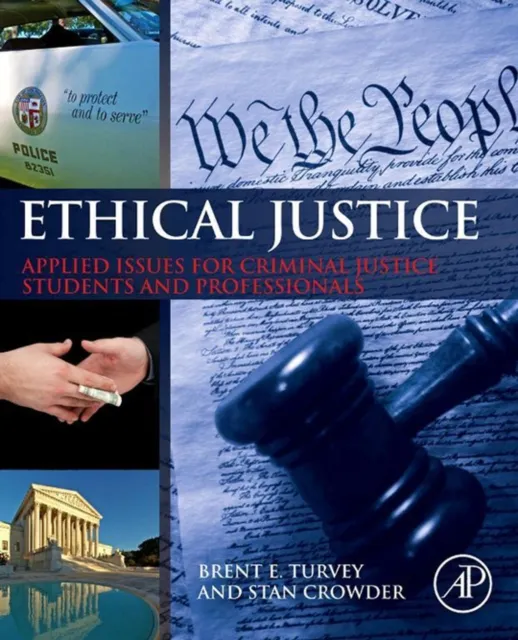
Ethical Justice
Applied Issues for Criminal Justice Students and Professionals

Introduction
This textbook was developed from an idiom shared by the authors and contributors alike: ethics and ethical challenges are generally black and white - not gray. They are akin to the pregnant woman or the gunshot victim; one cannot be a little pregnant or a little shot. Consequently, professional conduct is either ethical or it is not.
Unafraid to be the harbingers, Turvey and Crowder set forth the parameters of key ethical issues across the five pillars of the criminal justice system: law enforcement, corrections, courts, forensic science, and academia. It demonstrates how each pillar is dependent upon its professional membership, and also upon the supporting efforts of the other pillars - with respect to both character and culture.
With contributions from case-working experts across the CJ spectrum, this text reveals hard-earned insights into issues that are often absent from textbooks born out of just theory and research.
Part 1: Ethics in Academia
Examines ethic issues in academia, with chapters on ethics for CJ students, CJ educators, and ethics in CJ research.
Part 2: Ethical Issues in Law Enforcement
Examines ethical issues in law enforcement, with separate chapters on law enforcement administration and criminal investigations.
Part 3: Ethical Issues in Forensic Services
Considers the separate roles of crime lab administration and evidence examination.
Part 4: Ethical Issues in the Courts
Discusses the prosecution, the defense, and the judiciary.
Part 5: Ethical Issues in Corrections
Separately considers corrections staff and treatment staff in a forensic setting.
Part 6: Ethical Issues in Professional Practice
Examines ethical issues in a broad professional sense with respect to professional organizations and whistleblowers.
About the Book
Ethical Justice: Applied Issues for Criminal Justice Students and Professionals is intended for use as a textbook at the college and university, by undergraduate students enrolled in a program related to any of the CJ professions. It is designed to guide them through the real-world issues they will encounter both in the classroom and in the professional community. Additionally, it can serve as an important reference manual for CJ professionals working in communities lacking ethical mentoring or leadership.
Key Features
- First of its kind overview of the five pillars of criminal justice: academia, law enforcement, forensic services, courts, and corrections
- Written by practicing criminal justice professionals from across every pillar
- Offers a realistic overview of ethical issues confronted by criminal justice students and professionals
- Examines sensitive subjects often ignored in other criminal justice ethics texts
- Includes numerous case examples in each chapter to facilitate instruction and learning