£6.28
Epic Poem of Finland

Kalevala and Its Significance
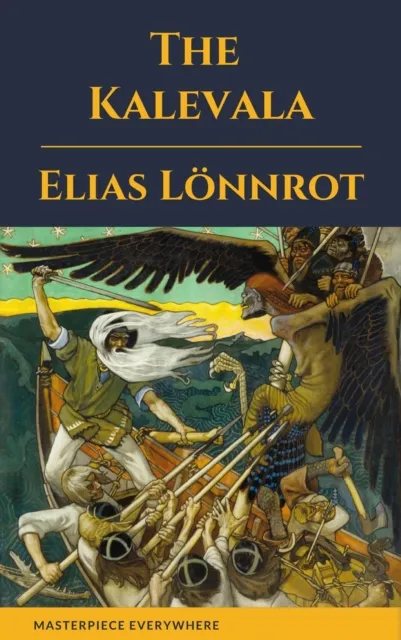
Kalevala or Kalewala can be interpreted as the land of Kaleva or Kalevia. Currently, this vast region is divided between the Russian Republic of Karelia, the Russian Leningrad Oblast, and Finland—specifically the regions of north and south Karelia. Much of Finnish poetry was of the oral tradition. But Kalevala is a national and unifying poem.
The authors of the work are numerous and stretch back almost countless centuries, but important additions and structuring are most notably from the eighteenth and nineteenth centuries, including Arhippa Perttunen, Juhana Kainulainen, Matiska, and Ontrei Malinen. From this myriad of sources, the work is now more often attributed to its compiler Elias Lönnrot, who, in the mid-19th century, made many field trips around the region to piece together this remarkable epic poem of Finnish folklore, history, mythology, and wisdom.
This epic had previously been told by storytellers, often as a duo alternating verses between themselves and sometimes accompanied by a kantele player—a stringed instrument similar to a dulcimer or zither. Despite the wide and diverse area of origin, the recital was always built on a pentachord and sung in the same metre, although the rhythm might vary. It is said to have been the inspiration for Longfellow's Hiawatha, which also uses the same metre.
Lönnrot was a doctor, linguist, and botanist who worked for the district health office in the eastern part of Finland and had a deep interest in these folkloric tales. He had previously published other works, but none of the size or significance of these 22,795 verses, which are divided into fifty songs or Runes (Finnish runot). This work is still regarded as the most important in Finnish literature and contributed to the development of the Finnish national identity from its initial publishing in 1835 (called The Old Kalevala) to the more widespread and popular 1849 version.
It is said that with its promotion of Finnish pride, language, and identity, Kalevala led to Finnish independence from Russia in 1917, but it can still be enjoyed today for its fascinating sagas and profound beauty.