£50.99
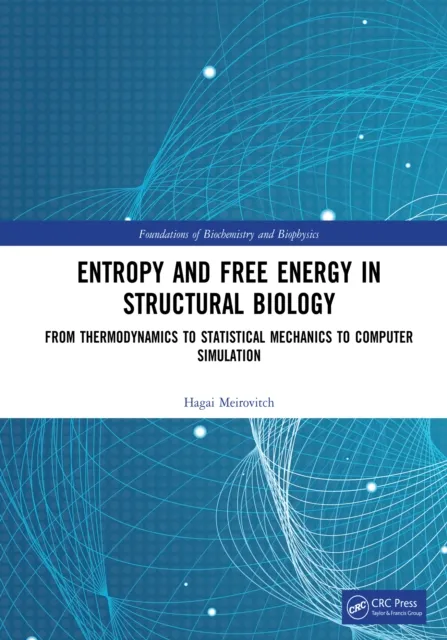
Entropy and Free Energy in Structural Biology
From Thermodynamics to Statistical Mechanics to Computer Simulation

Computer simulation has become the main engine of development in statistical mechanics. In structural biology, computer simulation constitutes the main theoretical tool for structure determination of proteins and for calculation of the free energy of binding, which are important in drug design. Entropy and Free Energy in Structural Biology leads the reader to the simulation technology in a systematic way. The book, which is structured as a course, consists of four parts:
Part I
is a short course on probability theory emphasizing (1) the distinction between the notions of experimental probability, probability space, and the experimental probability on a computer, and (2) elaborating on the mathematical structure of product spaces. These concepts are essential for solving probability problems and devising simulation methods, in particular for calculating the entropy.
Part II
starts with a short review of classical thermodynamics from which a non-traditional derivation of statistical mechanics is devised. Theoretical aspects of statistical mechanics are reviewed extensively.
Part III
covers several topics in non-equilibrium thermodynamics and statistical mechanics close to equilibrium, such as Onsager relations, the two Fick's laws, and the Langevin and master equations. The Monte Carlo and molecular dynamics procedures are discussed as well.
Part IV
presents advanced simulation methods for polymers and protein systems, including techniques for conformational search and for calculating the potential of mean force and the chemical potential. Thermodynamic integration, methods for calculating the absolute entropy, and methodologies for calculating the absolute free energy of binding are evaluated.
Enhanced by a number of solved problems and examples, this volume will be a valuable resource to advanced undergraduate and graduate students in chemistry, chemical engineering, biochemistry biophysics, pharmacology, and computational biology.