£149.99
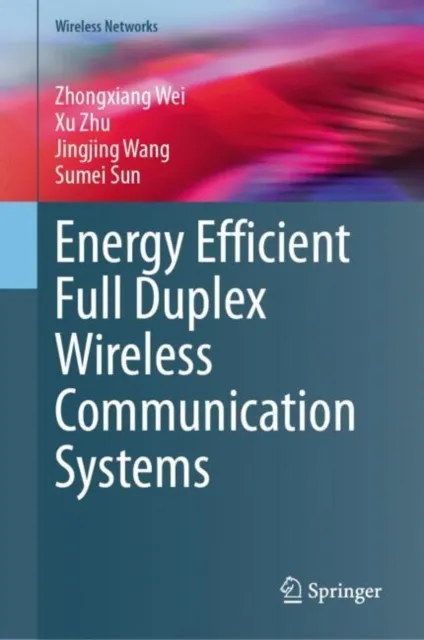
Energy Efficient Full Duplex Wireless Communication Systems

Introduction to Full-Duplex Communications
In an effort to overcome the spectral efficiency loss and high latency by half-duplex (HD), full-duplex (FD) has attracted extensive attention in industry and academia. With signal transmitted and received simultaneously over the same frequency, FD can approximately double the SE over HD. More than that, by enabling the capability of simultaneous transmission-and-reception for communication nodes, full duplex (FD) is a key enabler for many 5G techniques, including but not limited to integrated sensing and communication, low-latency relaying, concurrent bi-directional uplink and downlink transmission, etc. Nevertheless, in FD communications, both transmit and receive radio frequency (RF) chains are activated for exchanging data, and additional power is triggered by self-interference cancellation. As FD requires much higher power consumption than that of half duplex (HD), it is against the green evolution requirement proposed by the future communication systems.
Energy-Efficient Full-Duplex Design
To address the critical high-power challenge in applying FD communications, this book will introduce the fundamentals and algorithm designs for energy-efficient FD design. This book will first discuss the principle of energy-efficient communications, which aims to make a good balance between communication performance and system energy consumption. Then, this book will discuss different self-interference cancellation schemes, including passive suppression, analogue cancellation and digital cancellation for FD communications, from the perspective of energy efficiency. Subsequently, this book will present some edge-cutting energy efficiency-oriented FD solutions, including adaptive transmission power adaptation, wireless power transfer FD relaying, bi-directional FD distributed antenna systems, from the perspective of algorithm design and performance analysis.