£25.99
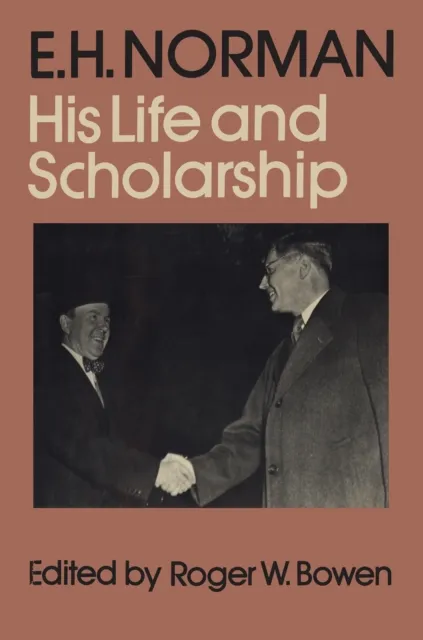
E.H. Norman
His Life and Scholarship

The ashes of Herbert Norman now lie in the British cemetery at Rome, near those of Shelley and Keats. His distinguished life and tragic death, in April 1957, are recalled and examined in this book by scholars and diplomats from four countries—the United States, Japan, Canada, and Britain.
Born in rural Japan the son of a Canadian missionary, Herbert Norman studied at the University of Toronto and went in 1933 to Cambridge University on a scholarship. There, in that intellectual hothouse where it seemed one had to choose politically between communism and fascism as the future of the West, he joined the Communist party—a move that became a crime later in the fixed and ‘sightless’ (as the editor describes them) eyes of his American accusers.
According to Edwin Reischauer, later the US ambassador to Japan, ‘his harassment by the American government was unforgiveable.’ His suicide in Cairo, while Canadian ambassador to Nasser’s Egypt during and after the delicate times of the Suez Crisis and the establishment of the UN peace-keeping force, raised broader questions for Lester Pearson—‘the right, to say nothing of the propriety, of a foreign government to intervene’ in Canadian affairs.
Norman was also a renowned historian of Japan. His Japan’s Emergence as a Modern State has been called a classic, and between 1946 and 1950, as head of the Canadian Liaison Mission in Tokyo, he was a close and friendly adviser to General Douglas MacArthur in his efforts to reconstitute that country. Both this work and his writings on Japan were sympathetic to human freedoms and democracy, and they too became controversial as sides congealed in the Cold War. Five papers in this book assess Norman’s scholarly work in the historiography of Japan.
Four lecture papers by Norman (three previously unpublished) are included which show his change from ‘a doctrinaire Marxist to a Jeffersonian Liberal,’ a change historians can accept as fact whereas intelligence agencies could not and remade Norman into a communist. He was not a spy, the editor concludes, and should be remembered as the hero of a modern tragedy.