£129.99
Efficient Control and Spontaneous Transitions

Thesis Overview
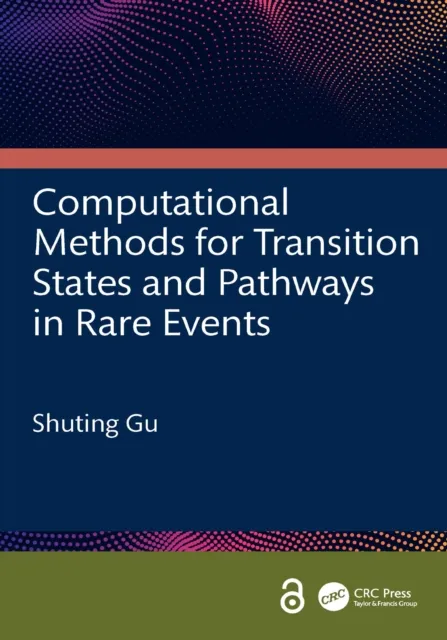
This thesis addresses deep questions that cut to the physical and informational essence of central chemical quantities such as transition paths and reaction mechanisms and proposes fundamental new connections between transition-path theory, linear-response theory, nonequilibrium thermodynamics, and information theory. The author investigates slow, energetically efficient driving protocols that drive a system between conformations corresponding to endpoints of a reaction, aiming to find connections between principles of efficient driving and the spontaneous transition mechanism in the absence of driving.
Development of Transition-Path Theory
First, an alternative perspective of transition-path theory is developed that unifies it with stochastic thermodynamics to describe flows of entropy, energy, and information during the reaction. This also provides an optimization criterion for selecting collective variables.
Designing Protocols for Magnetization Inversion
Next, protocols are designed which invert the magnetization of a 3×3 Ising model with minimal energetic cost, and it is determined that using multiple control parameters allows the system to be driven along a fast-relaxing pathway between reaction endpoints.
Comparison with Spontaneous Transition Mechanism
Finally, the author compares these protocols with the spontaneous transition mechanism for magnetization inversion in the same Ising model, finding that designed protocols capture general features of the spontaneous mechanism and energetics given the constraints on the control parameters. This work represents a major step forward in our understanding of rare events and provides a basis for investigating the connection between efficient protocols and spontaneous transition mechanisms which can be further probed in a wider variety of systems.