£27.99
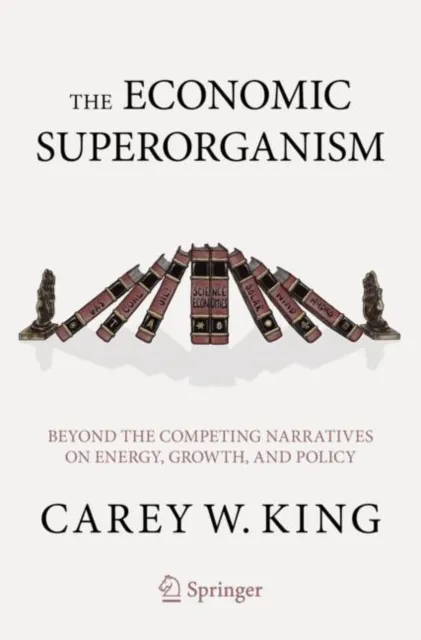
Economic Superorganism
Beyond the Competing Narratives on Energy, Growth, and Policy

Energy drives the economy, economics informs policy, and policy affects social outcomes. Since the oil crises of the 1970s, pundits have debated the validity of this sequence, but most economists and politicians still ignore it. Thus, they delude the public about the underlying influence of energy costs and constraints on economic policies that address such pressing contemporary issues as income inequality, growth, debt, and climate change. To understand why, Carey King explores the scientific and rhetorical basis of the competing narratives both within and between energy technology and economics.
Energy and economic discourse seems to mirror Newton’s 3rd Law of Motion: For every narrative there is an equal and opposite counter-narrative. The competing energy narratives pit "drill, baby, drill!" against renewable technologies such as wind and solar. Both claim to provide secure, reliable, clean, and affordable energy to support economic growth with the most benefit to society, but how? To answer this question, we need to understand the competing economic narratives, techno-optimism and techno-realism. Techno-optimism claims that innovation overcomes any physical resource constraints and enables the social outcomes and economic growth we desire. Techno-realism, in contrast, states that no matter what energy technologies we use, feedbacks from physical growth on a finite planet constrain economic growth and create an uneven distribution of social impacts. In The Economic Superorganism, you will discover stories, data, science, and philosophy to guide you through the arguments from competing narratives on energy, growth, and policy. You will be able to distinguish the technically possible from the socially viable, and understand how our future depends on this distinction.