£95.00
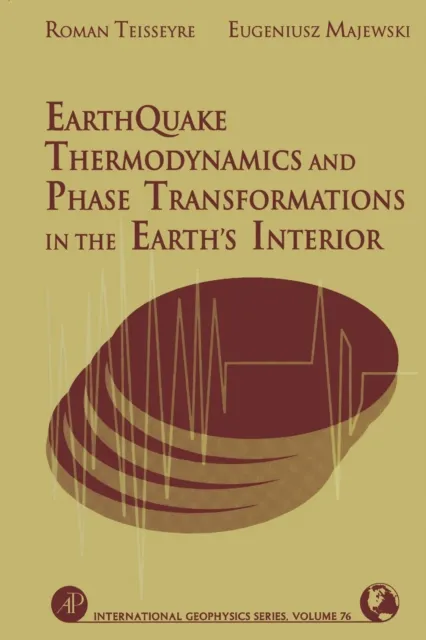
Earthquake Thermodynamics and Phase Transformation in the Earth's Interior

Introduction to Earth Sciences and Thermodynamics
A group of distinguished scientists contributes to the foundations of a new discipline in Earth sciences: earthquake thermodynamics and thermodynamics of formation of the Earth's interior structures. The predictive powers of thermodynamics are so great that those aspiring to model earthquakes and the Earth's interior will certainly wish to be able to use the theory.
Thermodynamics is our only method of understanding and predicting the behavior of many environmental, atmospheric, and geological processes. The need for Earth scientists to develop a functional knowledge of thermodynamic concepts and methodology is therefore urgent.
Entropy and Non-Linear Interactions
Sources of an entropy increase the dissipative and self-organizing systems driving the evolution and dynamics of the Universe and Earth through irreversible processes. The non-linear interactions lead to the formation of fractal structures. From the structural phase transformations, the important interior boundaries emerge.
Defects in Solids and Earthquake Mechanics
Non-linear interactions between the defects in solids lead the authors to develop the physics of continua with a dense distribution of defects. Disclinations and dislocations interact during a slow evolution as well as during rapid dynamic events, like earthquakes.
Splitting the dynamic processes into the 2D fault zone and 3D surrounding space brings a new tool for describing the slip nucleation and propagation along the earthquake faults. Seismic efficiency, rupture velocity, and complexity of seismic source zones are considered from different points of view. A fracture band earthquake model is developed on the basis of thermodynamics of line defects, like dislocations.
Earthquake Thermodynamics and Precursors
Earthquake thermodynamics offers us a microscopic model of earthquake sources. Physics of defects helps the authors describe and explain a number of precursory phenomena caused by the buildup of stresses. Anomalies in electric polarization and electromagnetic radiation prior to earthquakes are considered from this point of view.
Through the thermodynamic approach, the authors arrive at the fascinating question of the possibility of earthquake prediction.
Earth as a Multicomponent System
In general, the Earth is considered here as a multicomponent system. Transport phenomena as well as wave propagation and shock waves are considered in this system subjected also to chemical and phase transformations.