£41.99
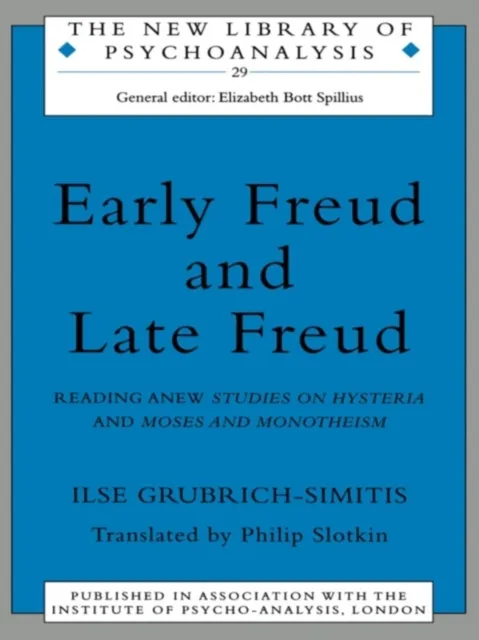
Early Freud and Late Freud
Reading Anew Studies on Hysteria and Moses and Monotheism

Ilse Grubrich-Simitis and Her Work
Ilse Grubrich-Simitis, well-known as a Freud scholar and editor of Freud's works, has long advocated a return to his original texts in order to comprehend fully the power and innovative force of his theories. In Early Freud and Late Freud she examines the earliest psychoanalytic book, Studies on Hysteria, which Freud wrote together with Breuer, and Moses and Monotheism, Freud's last book.
The Significance of Studies on Hysteria
The essay on Studies on Hysteria reveals to the reader why that book is indeed the ''primal book'' of psychoanalysis. Not only does it offer a moving and dramatic account of the birth of the psychoanalytic method, but by introducing the key concept of trauma it establishes a foundation on which much of modern psychoanalysis has been built.
Freud's Return to Trauma in Moses and Monotheism
Freud was to return to his original theory of trauma in his last book, Moses and Monotheism, where he developed it further in the light of his intervening researches. On the basis of her study of the Moses manuscripts and by applying the psychoanalytic method, Ilse Grubrich-Simitis shows how contemporary traumatic events in Nazi Germany may have influenced this return to the beginning and the intensification of Freud's self-analysis. This in turn was to lead to new insights into archaic forms of defence, pointing the way forward for modern psychoanalysis.
Conclusion
Elegantly constructed and persuasively argued, Early Freud and Late Freud re-establishes the importance of two major Freudian texts, offering a new understanding of their significance.