£119.99
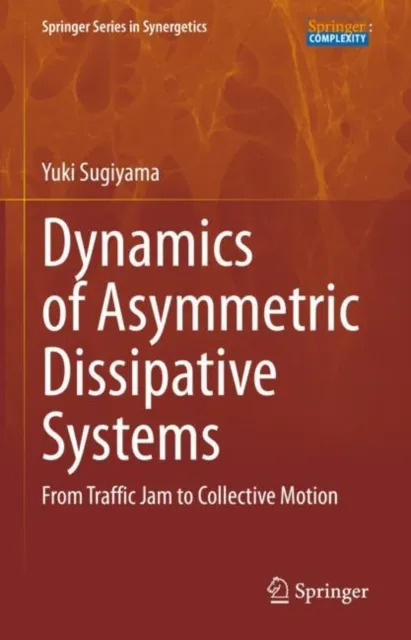
Dynamics of Asymmetric Dissipative Systems
From Traffic Jam to Collective Motion

Book Description
This book provides the dynamics of non-equilibrium dissipative systems with asymmetric interactions (Asymmetric Dissipative System; ADS). Asymmetric interaction breaks "the law of action and reaction" in mechanics, and results in non-conservation of the total momentum and energy. In such many-particle systems, the inflow of energy is provided and the energy flows out as dissipation. The emergences of non-trivial macroscopic phenomena occur in the non-equilibrium energy balance owing to the effect of collective motions as phase transitions and bifurcations. ADS are applied to the systems of self-driven interacting particles such as traffic and granular flows, pedestrians and evacuations, and collective movement of living systems. The fundamental aspects of dynamics in ADS are completely presented by a minimal mathematical model, the Optimal Velocity (OV) Model. Using that model, the basics of mathematical and physical mechanisms of ADS are described analytically with exact results.
Traffic Jam Formation
The application of 1-dimensional motions is presented for traffic jam formation. The mathematical theory is compared with empirical data of experiments and observations on highways.
Pattern Formation in 2D
In 2-dimensional motion pattern formations of granular media, pedestrians, and group formations of organisms are described. The common characteristics of emerged moving objects are a variety of patterns, flexible deformations, and rapid response against stimulus. Self-organization and adaptation in group formations and control of group motions are shown in examples.
Additional Topics
Another OV Model formulated by a delay differential equation is provided with exact solutions using elliptic functions. The relations to soliton systems are described. Moreover, several topics in ADS are presented such as the similarity between the spatiotemporal patterns, violation of fluctuation dissipation relation, and a thermodynamic function for governing the phase transition in non-equilibrium stationary states.