£41.99
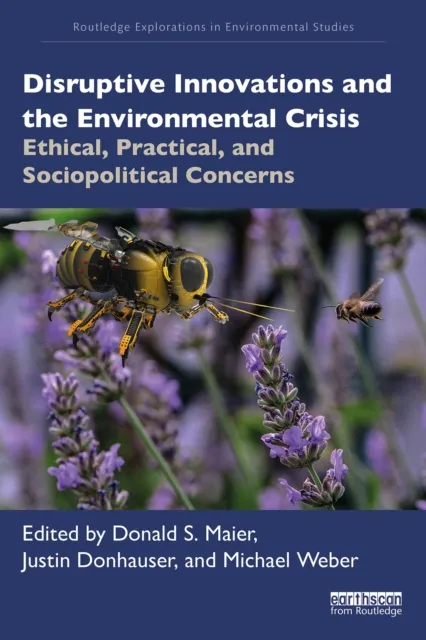
Disruptive Innovations and the Environmental Crisis
Ethical, Practical, and Sociopolitical Concerns

This book probes the ethical, practical, and sociopolitical implications of leveraging innovative and disruptive means to address the world’s various environmental crises.
Packed with keen observations and analyses, the volume brings together research from seasoned scholars and rising stars to cast important new light on urgent issues engendered by humankind’s disruption of environments, such as climate change and biodiversity loss. It tackles the question of exactly what has been disrupted in the world—environmentally, economically, socially, and politically. It also examines an assortment of innovative interventions that aim to address disruptions and explores the question of what further disruptions may lurk behind assorted innovative interventions intended to address already existing disruptions. Chapters wrestle with the social, ethical, and ecological implications of disruptions, both pre-existing and those brought about by interventions, connected with deploying artificial gene drives, substituting robotic pollinators for living ones, synthesizing organisms to replace ones lost, installing economic regimes that work well for both citizens and the environment, making science subservient to non-scientific commitments, involving citizens in environmentally consequential decisions, choosing scientific and technological projects that most promise immediate practical payoff, and ensuring that respect for human rights is part and parcel of any technology-infused project. These discussions draw on a rich mix of science, philosophy of science, political theory, economics, sociology, network theory, ethics, and theories of justice and human rights.
This book will be of great interest to students and scholars of environmental science, environmental decision-making, ecology, climate change, environmental philosophy, and the philosophy of science.