£44.99
Diasporic Agencies: Mapping the City Otherwise

Introduction
Diasporic Agencies addresses the neglected subject of how architecture and urban design can respond to the consequences of increasing migration. Arguing that diasporic inhabitations can only be understood as the co-production of space, subjectivity and politics, the book explores questions of difference, belonging and movement in the city.
Through focusing on a series of examples, it reveals how diasporas produce new types of spaces and develop new subjectivities in the contemporary European metropolis. It explores the way in which geo-politics affects individual lives and how national and regional borders inscribe themselves onto diasporic bodies.
Key Arguments
The book claims that the multiple belongings of diasporic citizens, half-here and half-there, provoke a crisis in the standard modes of architectural representation that tend to homogenise and flatten experience. Instead, Diasporic Agencies makes a case for a non-representational approach, where the displacement of the diasporic subject and their consequent reterritorialisation of space are developed as modes of thinking and doing.
Methodology and Tools
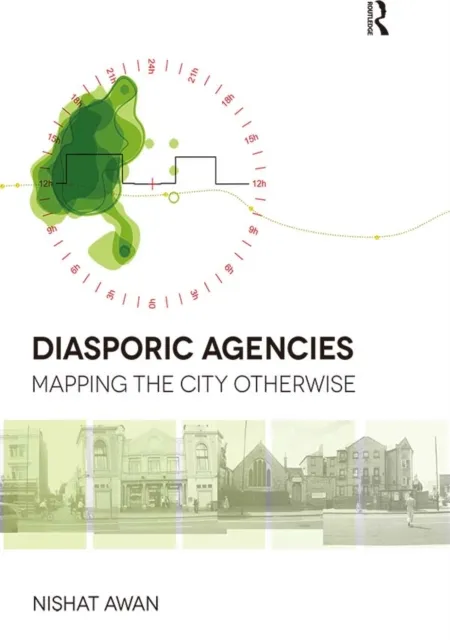
In parallel, mapping otherwise is proposed as a tool for spatial practitioners to work with these multi-layered spaces.
Intended Audience
The book is aimed at spatial practitioners and theorists of all sorts — architects, artists, geographers, urban designers — anyone with a general interest in mapping or those interested in working through issues related to migration and the contemporary city.