£30.99
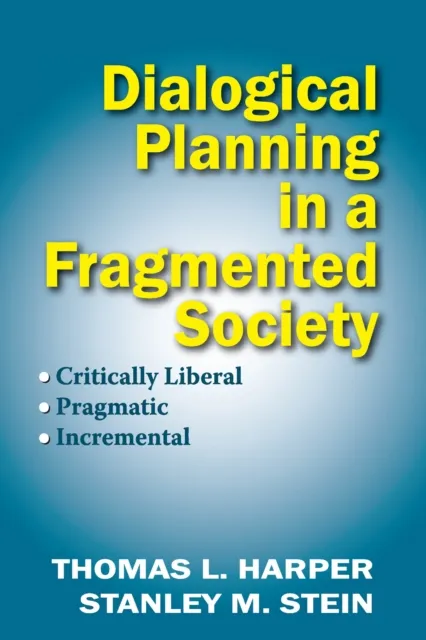
Dialogical Planning in a Fragmented Society
Critically Liberal, Pragmatic, Incremental

Introduction
The culmination of a critical study of neo-pragmatism philosophy and its application to planning, Dialogical Planning in a Fragmented Society begins with philosopher Stanley M. Stein's examination of neo-pragmatism and his thoughts on how it can be useful in the field of environmental design—specifically, how it can be applied to planning procedures and problems.
Neo-pragmatism and Its Influences
Neo-pragmatism is an approach that has been, in the past, best expressed or implied in the writing of Hilary Putnam, Richard Rorty, and, in particular, Donald Davidson, John Rawls, and Ludwig Wittgenstein.
Contributions of Thomas L. Harper
Thomas L. Harper furthers this tradition by providing the context for this theoretical application from his academic background in economics and management as well as his practical experience with political decision-making processes, community planning, and economic development. The result is a fresh synthesis of ideas—a new approach to thinking about planning theory and its implications for, and relationship with, practice.
Philosophy and Politics
Philosopher Michael Walzer has asserted that "philosophy reflects and articulates the political culture of its time, and politics presents and enacts the arguments of philosophy." Similarly, the authors view planning theory as planning reflected upon in tranquility, away from the tumult of battle, and planning practice as planning theory acted out in the confusion of the trenches. Each changes the other in a dynamic way, and the authors demonstrate the intimate and inextricable link between them.