£46.99
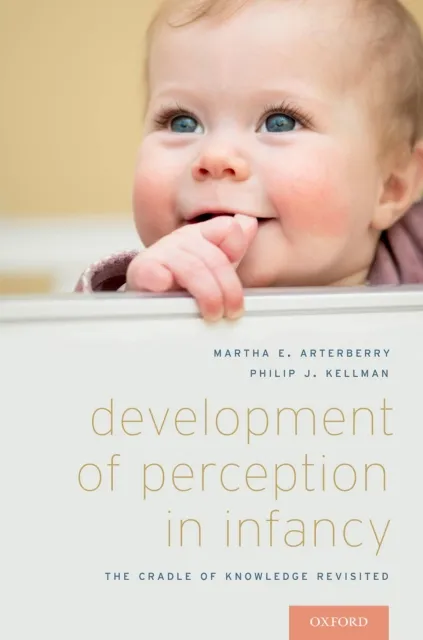
Development of Perception in Infancy
The Cradle of Knowledge Revisited

Introduction
The developing infant can accomplish all important perceptual tasks that an adult can, albeit with less skill or precision. Through infant perception research, infant responses to experiences enable researchers to reveal perceptual competence, test hypotheses about processes, and infer neural mechanisms, and researchers are able to address age-old questions about perception and the origins of knowledge.
Book Overview
In Development of Perception in Infancy: The Cradle of Knowledge Revisited, Martha E. Arterberry and Philip J. Kellman study the methods and data of scientific research on infant perception, introducing and analyzing topics (such as space, pattern, object, and motion perception) through philosophical, theoretical, and historical contexts.
Philosophical and Theoretical Contexts
Infant perception research is placed in a philosophical context by addressing the abilities with which humans appear to be born, those that appear to emerge due to experience, and the interaction of the two. The theoretical perspective is informed by the ecological tradition, and from such a perspective the authors focus on the information available for perception, when it is used by the developing infant, the fit between infant capabilities and environmental demands, and the role of perceptual learning.
Developmental Changes and Significance
Since the original publication of this book in 1998 (MIT), Arterberry and Kellman address in addition the mechanisms of change, placing the basic capacities of infants at different ages and exploring what it is that infants do with this information. Significantly, the authors feature the perceptual underpinnings of social and cognitive development, and consider two examples of atypical development - congenital cataracts and Autism Spectrum Disorder.
Target Audience
Professionals and students alike will find this book a critical resource to understanding perception, cognitive development, social development, infancy, and developmental cognitive neuroscience, as research on the origins of perception has changed forever our conceptions of how human mental life begins.