£54.99
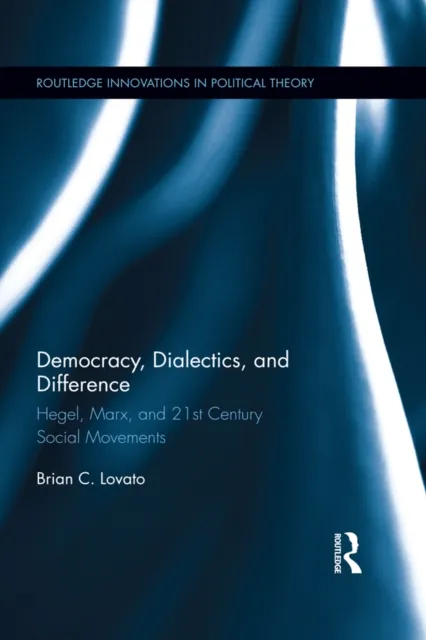
Democracy, Dialectics, and Difference
Hegel, Marx, and 21st Century Social Movements

Introduction
It has been nearly two centuries since Marx famously turned Hegel on his head in order to repurpose dialectics as a revolutionary way of thinking about the internal contradictions of our social relations. Despite critiques from post-structuralists, post-colonialists, and others, there has been a resurgence of dialectical thought among political theorists as of late. This resurgence has coincided with a rise in the mention of words like class warfare, socialism, and communism among the general public on the streets of Seattle in 1999, in Cairo’s Tahrir Square, in the actions of the Greek anarchists and the Spanish indignados, and in the rallying cry of "we are the 99%" of the Occupy Movement, and in academia. This book explores how it is that dialectical thought might respond to the critiques brought forth by those on the left who are critical of Marxism’s universalizing and authoritarian legacy.
Key Interlocutors and Theoretical Perspectives
Brian C. Lovato singles out Ernesto Laclau and Chantal Mouffe as the key interlocutors in this ongoing conversation between Marxism and post-structuralism. Laclau and Mouffe argue that Marxist theory is inherently authoritarian, cannot escape a class-reductionist theory of revolutionary subjectivity, and is bound by a closed Hegelian ontology. Lovato argues the opposite by turning to two heterodox Marxist thinkers, Raya Dunayevskaya and C. L. R. James, in order to construct a radically democratic, dynamic, and open conceptualization of dialectical thought. In doing so, he advances a vision of Marxist theory that might serve as a resource to scholars and activists committed not only to combatting capitalism, but also to fighting against colonialism, patriarchy, white supremacy, and heteronormativity. The writings of Dunayevskaya and James allow for Marxism to become relevant again in these tumultuous early years of the 21st century.