£44.99
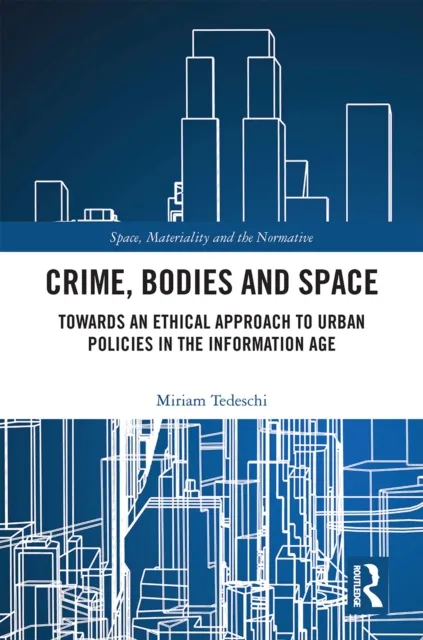
Crime, Bodies and Space
Towards an Ethical Approach to Urban Policies in the Information Age

Introduction
With cities increasingly following rigid rules for designing out crime and producing spaces under surveillance, this book asks how information shapes bodies, space, and, ultimately, policymaking.
In recent years, public spaces have changed in Western countries, with the urban realm becoming an ever-more monitored, privatised, homogeneous, and aseptic space that has lost its character, uniqueness, and diversity in the name of security. This underpins precise moral and political choices in terms of what a space should be, how it can be used, and by whom. These choices generate material consequences concerning urban inequality and freedom, or otherwise, of movement.
Based on ethnographic and autoethnographic explorations in London’s ‘criminal’ spaces, this book illustrates how rules, policies, and moral values, far from being abstract concepts, are in fact material. Outlining the basis of a new urban information ethics, the book both exposes and challenges how moral values and predefined categories are applied to, and materially shape, the movement of bodies in urban space with regard to crime and security policies.
Drawing on Gilbert Simondon’s information theory and a wide range of work in urban studies, geography, and planning, as well as in surveillance studies, object-oriented ontology, and contemporary theoretical work on both materiality and affect, the book provides a radically new perspective on urban space in general, and crime and security in particular. This book uses a balanced mix of theoretical concepts and empirical study to bring theory and practice together in an intertwining of ethnography and autoethnography.
This book will be of interest to students and scholars in the fields of urban studies, urban geography, sociology, surveillance studies, legal theory, socio-legal studies, planning law, environmental law, and land law.