£94.99
Corporate Responsibility Code Book

Introduction
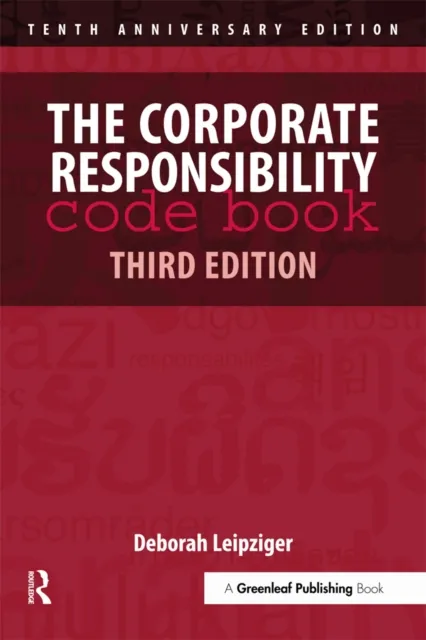
The Corporate Responsibility Code Book has become the go-to guide for companies trying to understand the landscape of corporate responsibility and searching for their own, unique route towards satisfying diverse stakeholders. There is no one-size-fits-all approach. A company may face quite different challenges if it operates in more than one part of the world. And yet stakeholders, especially consumers and investors, are keen for some degree of comparability with which they can evaluate corporate performance. There are countervailing forces at work within corporate responsibility: on the one hand is the need for convergence in order to simplify the large numbers of codes and standards; and, on the other hand, the need to foster diversity and innovation.
Challenges and Effectiveness of Codes
Many of the best codes of conduct and standards are not well known, while some CR instruments that are well disseminated are not terribly effective. Some comprehensive codes of conduct achieve nothing, while other quite vague codes of conduct become well embedded into the organization and foster innovation and change. This landmark book explains the best CR instruments available, and distils their most valuable elements.
Updated Content in the Third Edition
In the fully revised third edition, Deborah Leipziger widens her lens to provide detailed analysis of the UN Guiding Principles on Business and Human Rights, the Gender Equality Principles and ISO 26000 while updating other key tools such as the Equator Principles, the OECD guidelines and GRI’s new G4 framework.
Scope of the Codes
The codes in this book cover a wide range of issues, including human rights, labour rights, environmental management, corruption and corporate governance. The book also includes how-to (or process) codes focusing on reporting, stakeholder engagement and assurance.