£54.99
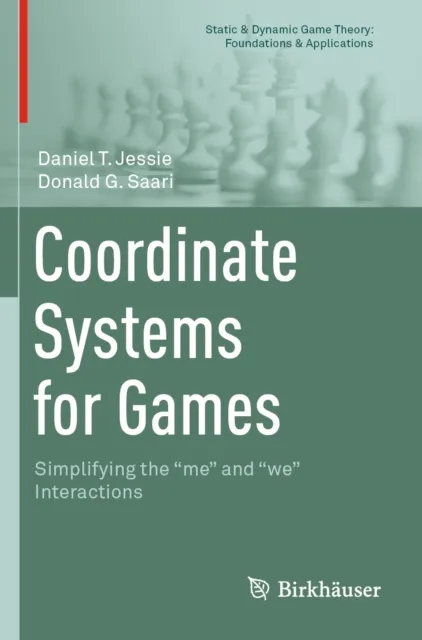
Coordinate Systems for Games
Simplifying the "me" and "we" Interactions

Overview
This monograph develops a method of creating convenient coordinate systems for game theory that will allow readers to more easily understand, analyze, and create games at various levels of complexity. By identifying the unique characterization of games that separates the individual’s strategic interests from the group’s collective behavior, the authors construct a single analytical methodology that readers will be able to apply to a wide variety of games. With its emphasis on practicality and approachability, readers will find this book an invaluable tool, and a viable alternative to the ad hoc analytical approach that has become customary for researchers utilizing game theory.
Introduction and Content
The introductory chapters serve two important purposes: they review several games of fundamental importance, and also introduce a dynamic that is inherent in games, but has gone unexplored until now. After this has been established, readers will advance from simple 2 x 2 games to games with more player strategies and dynamics. For interested readers, a rigorous treatment of the underlying mathematics is conveniently gathered at the end of the book. Additional topics of interest, such as extensive form and coalitional games, are presented to help readers visualize more complex settings that will be vital in aiding the understanding of advanced topics, such as coalition-free Nash points, multi-player repeated games, and more.
Intended Audience
Coordinate Systems for Games is ideal for a wide variety of researchers interested in game theory, including social scientists, economists, mathematicians, computer scientists, and more. The authors' approachable style also makes this accessible to an audience at any scale of experience, from beginning non-specialists to more practiced researchers.