£44.99
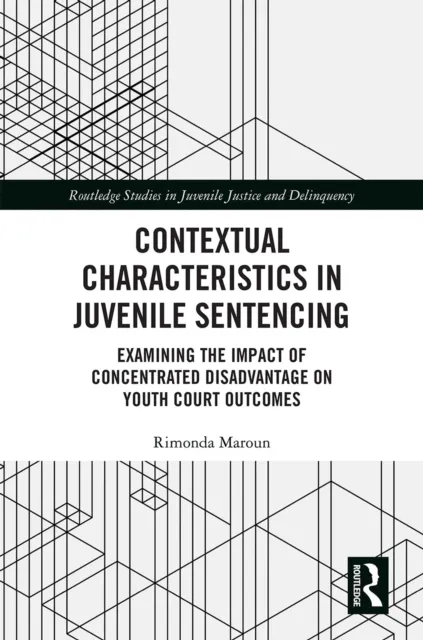
Contextual Characteristics in Juvenile Sentencing
Examining the Impact of Concentrated Disadvantage on Youth Court Outcomes

Introduction
While there is extensive research published concerning juvenile justice and sentencing, most of the research focuses on individual and extra-legal factors, such as age, race, and gender, with scant attention paid to the impact of macro-level factors. This book assesses how a specific contextual factor—concentrated disadvantage—impacts juvenile court outcomes and considers the relevant implications for the current state of juvenile justice processing.
Methodology and Findings
Using case-level data from a Southern state with a large, diverse population and contextual-level data from the 2010 US Census and American Community Survey, Maroun assesses whether youth living in neighborhoods of concentrated disadvantage experience harsher outcomes than their counterparts from other types of neighborhoods. Additionally, she examines whether concentrated disadvantage interacts with individual race/ethnicity to influence juvenile court outcomes. Results suggested a direct impact of concentrated disadvantage on diversion, adjudication, and probation type. Further, race significantly interacted with concentrated disadvantage in impacting adjudication and probation outcomes, while ethnicity significantly interacted with concentrated disadvantage in impacting disposition and commitment type.
Implications
This research expands the knowledge of macrolevel influences on juvenile court outcomes, providing support for the notion that community context impacts juvenile justice processing. Results also highlight the fact that judges use discretion as well as other legal and extralegal factors in exerting social control, and do so differently at each stage of processing. This monograph is essential reading for those engaged in youth and juvenile justice efforts and scholars interested in issues surrounding race, class, social policy, and justice.