£18.99
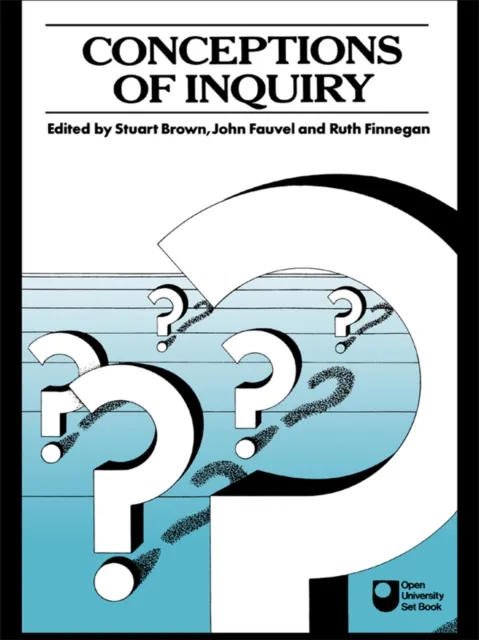
Conceptions of Inquiry

Introduction
A number of significant contributions have been made, both to specific intellectual disciplines and on the broader philosophical front, by researches into the nature of inquiry. The papers in this collection illustrate a number of such areas of debate in mathematics, natural science, social studies, and history, allowing an appraisal of their importance in their own context as well as comparisons across disciplinary frontiers. Some extracts are undoubtedly classic - Plato on mathematics, Newton on physics, and J.S. Mill on social science. However, most contributions are more contemporary - work by theorists such as Foucault and Hofstadter, and by practitioners such as Bondi and Einstein.
Mathematics and Natural Science
Mathematics is considered under a number of headings, from Plato's eternal truth to Hodgkin's social practice. Its relation to the real world is discussed in a number of essays. In the section on natural science, various strands of the Popper-Kuhn debate can be followed, including the questions of progress, rationality, and the demarcation of science as opposed to pseudo-science.
Social Inquiry
A similar set of problems is presented in the sections on social inquiry. Here, the scientific status of sociology, anthropology, history, and the like is at issue. Some writers argue that social inquiry is quite distinct from science, whilst others, including Hempel, deny that there is any essential difference between the human and the natural sciences.
General Problems
The final sections are devoted to more general problems. Extracts from Hume, Hirst, and Foucault discuss the isolation and definition of forms of knowledge; the prevailing views of the objectivity of science are challenged by Hanson and Kuhn; and the role of values in social inquiry is debated by Weber, Gouldner, and Hesse.