£30.99
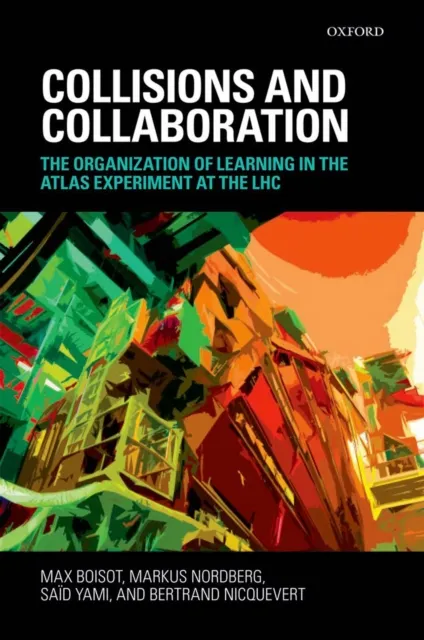
Collisions and Collaboration
The Organization of Learning in the ATLAS Experiment at the LHC

Introduction
After twenty-five years of preparation, the Large Hadron Collider at CERN, Geneva, is finally running its intensive scientific experiments into high-energy particle physics. These experiments, which have so captured the public's imagination, take the world of physics to a new energy level, the terascale, at which elementary particles are accelerated to one millionth of a percent of the speed of light and made to smash into each other with a combined energy of around fourteen trillion electron-volts. What new world opens up at the terascale? No one really knows, but the confident expectation is that radically new phenomena will come into view.
The kind of big science being pursued at CERN, however, is becoming ever more uncertain and costly. Do the anticipated benefits justify the efforts and the costs? This book aims to give a broad organizational and strategic understanding of the nature of big science by analyzing one of the major experiments that uses the Large Hadron Collider, the ATLAS Collaboration. It examines such issues as: the flow of interlaced knowledge between specialist teams; the intra- and inter-organizational dynamics of big science; the new knowledge capital being created for the workings of the experiment by individual researchers, suppliers, and e-science and ICTs; the leadership implications of a collaboration of nearly three thousand members; and the benefits for the wider societal setting.
This book aims to examine how, in the face of high levels of uncertainty and risk, ambitious scientific aims can be achieved by complex organizational networks characterized by cultural diversity, informality, and trust - and where big science can head next.