£3.99
Clarks of Kentucky

When John Clark Married Ann Rogers in 1749 in Virginia
they would eventually produce ten children—six sons and four daughters. Like most early American rural couples, John and Ann thought that they were raising farm hands and kitchen help. Little did they dream that their children and two more generations of Clarks would have such a great impact on America's development from coast to coast.
Revolutionary War Contributions
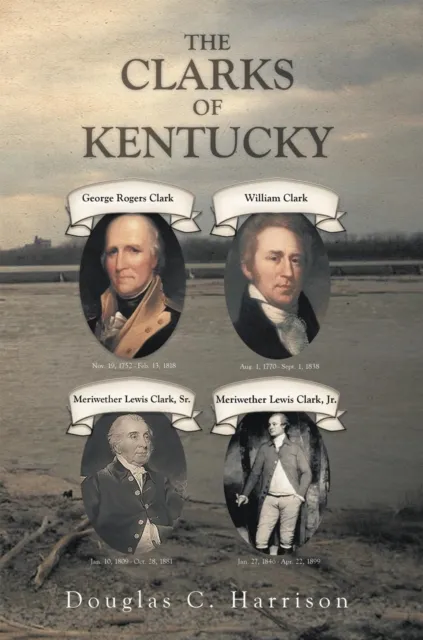
Three of the Clark sons would become officers, and help to win the Revolutionary War in the east. George Rogers Clark would become a general and win the Revolution in the west, thus giving America the eastern one third of the continent. George would also found Louisville, and the state of Kentucky.
William Clark and Exploration
William Clark, as the youngest Clark son, was seventeen years younger than big brother George, his hero. William would also pursue a military career, and partner with Meriwether Lewis to explore the Louisiana Purchase, thus giving America the middle third of the continent. William would later become a great Indian diplomat, and help to establish the state of Missouri.
Meriwether Lewis, Sr. and Military Service
William's son Meriwether Lewis, Sr. (Lewis) would go to West Point, become a famous architect, and fight in three wars. They included the Mexican War, which gave America the western third of the continent.
Meriwether Lewis Clark, Jr. and the Kentucky Derby
Lewis's son Meriwether Lewis Clark, Jr. (Lutie) would basically save the thoroughbred industry in Kentucky and America after the Civil War. He created the pari-mutuel system of betting, set up racing rules, and started Churchill Downs and the Kentucky Derby—all of which still exist.
Migration to Louisville
John and Ann Clark and all of the other living offspring eventually moved to Louisville, and added to the Clarks of Kentucky.