£44.99
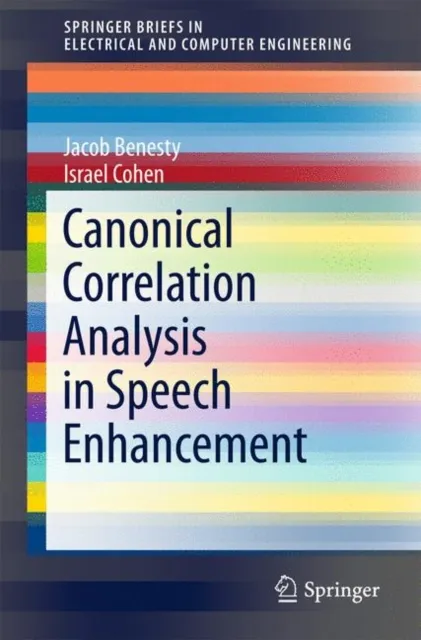
Canonical Correlation Analysis in Speech Enhancement

Application of Canonical Correlation Analysis to Speech Enhancement
This book focuses on the application of canonical correlation analysis (CCA) to speech enhancement using the filtering approach. The authors explain how to derive different classes of time-domain and time-frequency-domain noise reduction filters, which are optimal from the CCA perspective for both single-channel and multichannel speech enhancement. Enhancement of noisy speech has been a challenging problem for many researchers over the past few decades and remains an active research area. Typically, speech enhancement algorithms operate in the short-time Fourier transform (STFT) domain, where the clean speech spectral coefficients are estimated using a multiplicative gain function. A filtering approach, which can be performed in the time domain or in the subband domain, obtains an estimate of the clean speech sample at every time instant or time-frequency bin by applying a filtering vector to the noisy speech vector.
Compared to the multiplicative gain approach, the filtering approach more naturally takes into account the correlation of the speech signal in adjacent time frames. In this study, the authors pursue the filtering approach and show how to apply CCA to the speech enhancement problem. They also address the problem of adaptive beamforming from the CCA perspective, and show that the well-known Wiener and minimum variance distortionless response (MVDR) beamformers are particular cases of a general class of CCA-based adaptive beamformers.