£69.99
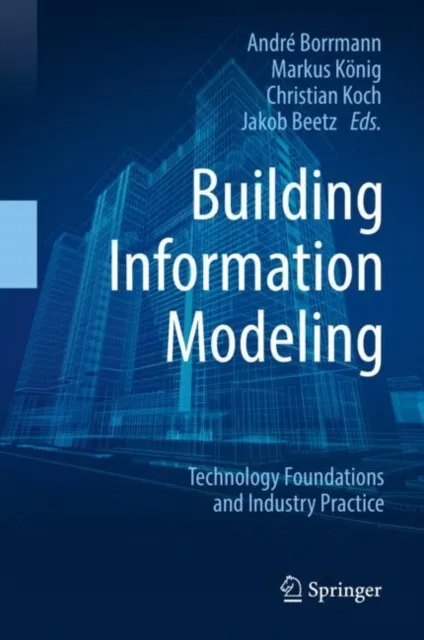
Building Information Modeling
Technology Foundations and Industry Practice

Building Information Modeling (BIM)
Building Information Modeling (BIM) refers to the consistent and continuous use of digital information throughout the entire lifecycle of a built facility, including its design, construction and operation. In order to exploit BIM methods to their full potential, a fundamental grasp of their key principles and applications is essential. Accordingly, this book combines discussions of theoretical foundations with reports from the industry on currently applied best practices.
Content Structure
The book’s content is divided into six parts: Part I discusses the technological basics of BIM and addresses computational methods for the geometric and semantic modeling of buildings, as well as methods for process modeling. Next, Part II covers the important aspect of the interoperability of BIM software products and describes in detail the standardized data format Industry Foundation Classes. It presents the different classification systems, discusses the data format CityGML for describing 3D city models and COBie for handing over data to clients, and also provides an overview of BIM programming tools and interfaces. Part III is dedicated to the philosophy, organization and technical implementation of BIM-based collaboration, and discusses the impact on legal issues including construction contracts. In turn, Part IV covers a wide range of BIM use cases in the different lifecycle phases of a built facility, including the use of BIM for design coordination, structural analysis, energy analysis, code compliance checking, quantity take-off, prefabrication, progress monitoring and operation. In Part V, a number of design and construction companies report on the current state of BIM adoption in connection with actual BIM projects, and discuss the approach pursued for the shift toward BIM, including the hurdles taken. Lastly, Part VI summarizes the book’s content and provides an outlook on future developments.
Intended Audience
The book was written both for professionals using or programming such tools, and for students in Architecture and Construction Engineering programs.