£35.00
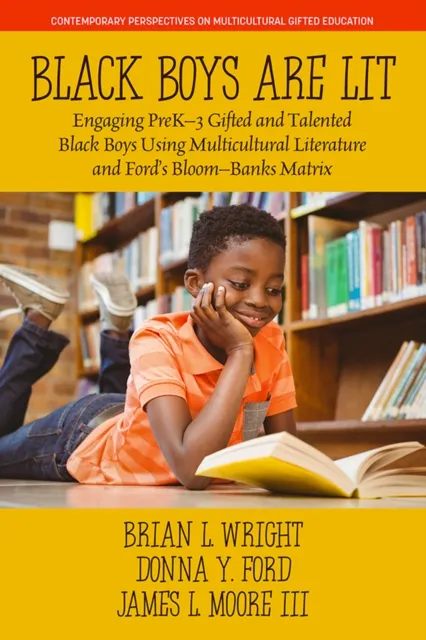
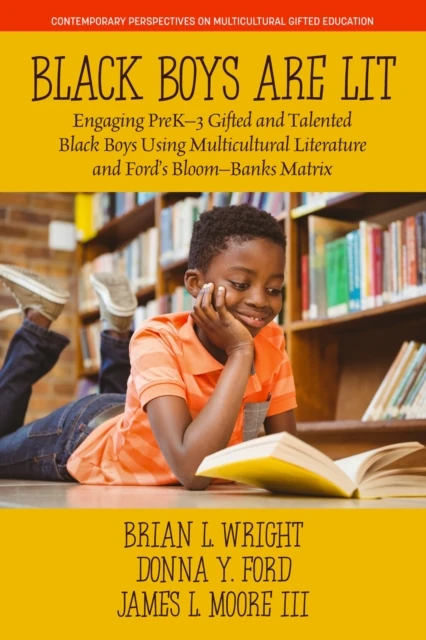
Black Boys are Lit
Engaging PreK-3 Gifted and Talented Black Boys Using Multicultural Literature and Ford's Bloom-Banks Matrix

Introduction
This book of matrices with Black boys as the main character is designed to help gifted and talented education teachers leverage Black boys' identities to inform and shape how they plan and deliver curriculum and instruction and manage the multicultural, democratic, and culturally responsive classroom. Ford and colleagues (2005) spoke to the notion of and need for self-reflective instruction.
We argue that all teachers must want to and learn how to legitimize the “everyday” experiences that are learned and cultivated in the homes and communities of Black boys, and how these experiences shape their self-identities and contribute to agency (Wright, Counsell, & Tate 2015).
Centering Black Identities
We, therefore, advocate for the rethinking of literacies by repositioning White-centered texts that often reflect and represent power and privilege toward centering the brilliance of Black identities of Black children in general, Black boys in particular. Black boys (of all ages) want to and need to physically see positive images of themselves in books reflected at them.
This representation, we argue, has the potential to become an example of a compelling counter-narrative to the history of the “all-White world” (Larrick, 1965) of children's books that only presented Black characters as “objects of ridicule and generally inferior beings” (Sims Bishop 2012, p. 6).
Importance of Representation
When Black boys see themselves portrayed visually, textually, and realistically in children's books, vital messages of recognition, value, affirmation, and validation are conveyed. Recognition of the sociocultural contexts in which they live is celebrated.
Creating Authentic and Multicultural Books
Books for and about Black boys must be rigorous, authentic, multicultural, and developmentally appropriate to allow them to synthesize what they have read, heard, and seen during literacy instruction in authentic and meaningful ways. Multicultural books must introduce children to information about the values of justice, fairness, and equity.
Developmentally appropriate books should vary with and adapt to the age, experience, and interests of gifted and talented Black boys to allow them the opportunity to demonstrate critical thinking, textual analysis skills and convey conceptual knowledge.
Counter Stories and Positive Narratives
These stories must expose Black boys to culturally relevant counter stories -- stories that counteract the dominant discourse that has primarily depicted Black boys as “at risk” versus placed at risk; “without hope” versus hopeful; or “out of control and dangerous” (Tatum, 2005, p. 28) versus developing self-control like all other children (Wright et al., 2018).