£46.99
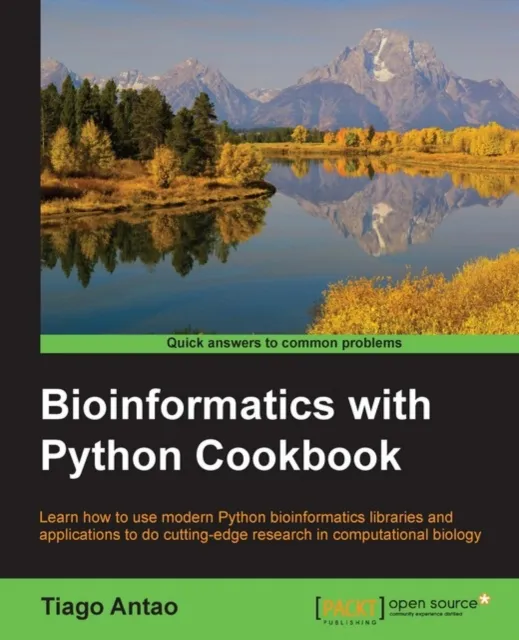
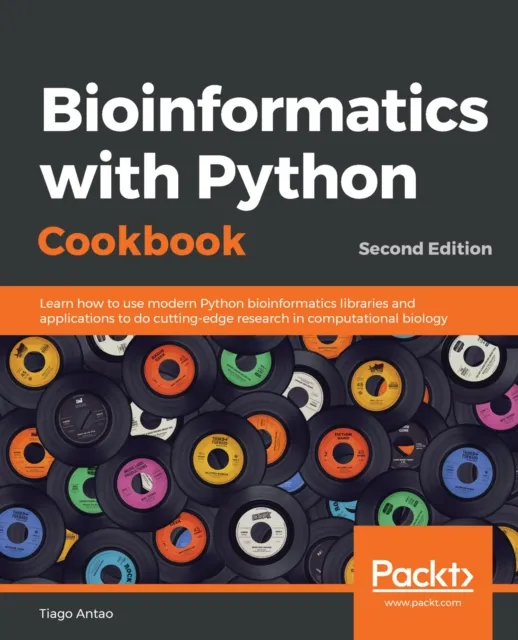
Bioinformatics with Python Cookbook
Learn how to use modern Python bioinformatics libraries and applications to do cutting-edge research in computational biology, 2nd Edition

Discover modern, next-generation sequencing libraries from Python ecosystem to analyze large amounts of biological data
Key Features
Perform complex bioinformatics analysis using the most important Python libraries and applications
Implement next-generation sequencing, metagenomics, automating analysis, population genetics, and more
Explore various statistical and machine learning techniques for bioinformatics data analysis
Book Description
Bioinformatics is an active research field that uses a range of simple-to-advanced computations to extract valuable information from biological data.
This book covers next-generation sequencing, genomics, metagenomics, population genetics, phylogenetics, and proteomics. You''ll learn modern programming techniques to analyze large amounts of biological data. With the help of real-world examples, you''ll convert, analyze, and visualize datasets using various Python tools and libraries.
This book will help you get a better understanding of working with a Galaxy server, which is the most widely used bioinformatics web-based pipeline system. This updated edition also includes advanced next-generation sequencing filtering techniques. You''ll also explore topics such as SNP discovery using statistical approaches under high-performance computing frameworks such as Dask and Spark.
By the end of this book, you''ll be able to use and implement modern programming techniques and frameworks to deal with the ever-increasing deluge of bioinformatics data.
What you will learn
Learn how to process large next-generation sequencing (NGS) datasets
Work with genomic dataset using the FASTQ, BAM, and VCF formats
Learn to perform sequence comparison and phylogenetic reconstruction
Perform complex analysis with proteomics data
Use Python to interact with Galaxy servers
Use High-performance computing techniques with Dask and Spark
Visualize protein dataset interactions using Cytoscape
Use PCA and Decision Trees, two machine learning techniques, with biological datasets
Who this book is for
This book is for data scientists, bioinformatics analysts, researchers, and Python developers who want to address intermediate-to-advanced biological and bioinformatics problems using a recipe-based approach. Working knowledge of the Python programming language is expected.