£23.99
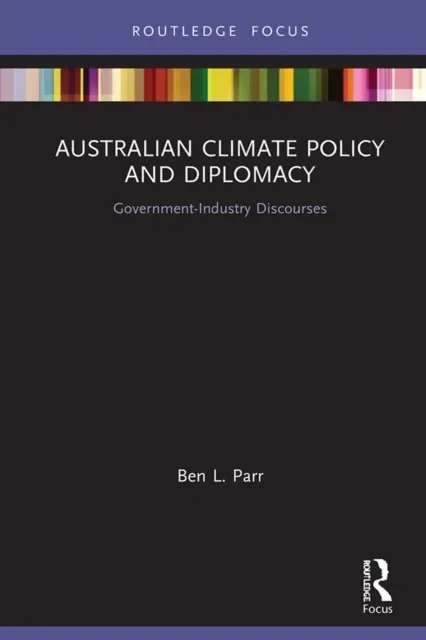
Australian Climate Policy and Diplomacy
Government-Industry Discourses

Australian Climate Policy and Diplomacy
Provides a well overdue critique of existing, and high-profile, publications that convey the ‘greenhouse mafia’ hypothesis, which posits that Australia’s weak policy response to climate change is the result of a menacing domestic fossil fuel lobby.
Ben L. Parr argues that the shared government–industry discourse about protecting Australia’s industrial competitiveness has had a more decisive influence in shaping and legitimising Australian climate policy than the direct lobbying tactics of the fossil fuel industry. Parr also reveals how the divergent foreign policy discourses and traditions of Australia’s two major political parties – as internationalist versus alliance-focused – have enabled and constrained their climate diplomacy and domestic policies over time. To demonstrate his argument, he presents a discourse analysis woven into a chronological policy narrative, comprising more than 1000 primary texts (media releases, interviews, and speeches) generated by prime ministers and key fossil fuel lobbyists. Overall, this volume illustrates how domestic forces have and are influencing Australia’s climate policy. In doing so, it also provides a framework that can be adapted to examine climate mitigation policies in other countries, notably Canada and the US.
This book will be of interest to students and scholars of climate change, environmental policy and governance, and Australian climate change policy and politics more specifically, as well as policymakers and practitioners working in these fields.