£41.99
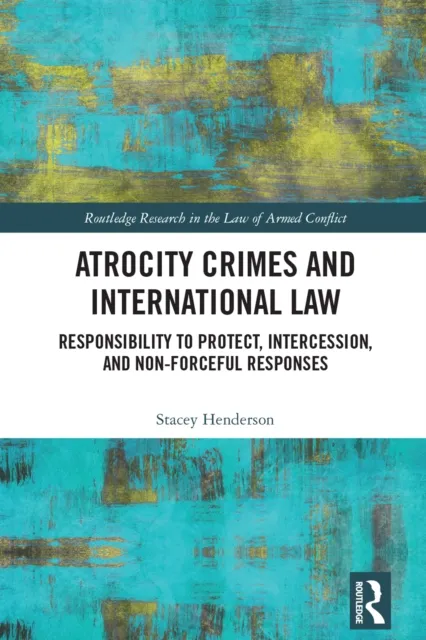
Atrocity Crimes and International Law
Responsibility to Protect, Intercession, and Non-Forceful Responses

Introduction
Despite repeated declarations of ‘never again’ in response to the commission of atrocities, civilians have continued to be targeted by their leaders and opposition groups. The international law principles of sovereignty and non-intervention, when taken at their highest, require States to stand idle and not intervene in another State regardless of what atrocities may be occurring there.
Challenging Traditional Views
This traditional legal view is being challenged by an emerging practice of States choosing to respond in non-forceful ways, inspired by the concept of the Responsibility to Protect (R2P). Drawing on R2P, this book introduces and develops an original conceptual tool – intercession – to capture and explain this change in State practice and the impact of R2P on the development of international law.
Exploration of State Practice
Through a close examination of State practice, the work explores whether there has been an expansion in the permissible measures and situations in which States can intervene, without using force, in response to atrocity crimes occurring in other States.
Conclusion and Significance
This book concludes that the development of the secondary duty on the international community under R2P provides the greatest opportunity to progress the R2P framework in a meaningful way, which will have a significant impact on the protection of populations from atrocity crimes. The book will be essential reading for students, researchers and policymakers working in the areas of international law, international relations, humanitarian law, and peace and security studies.