£99.50
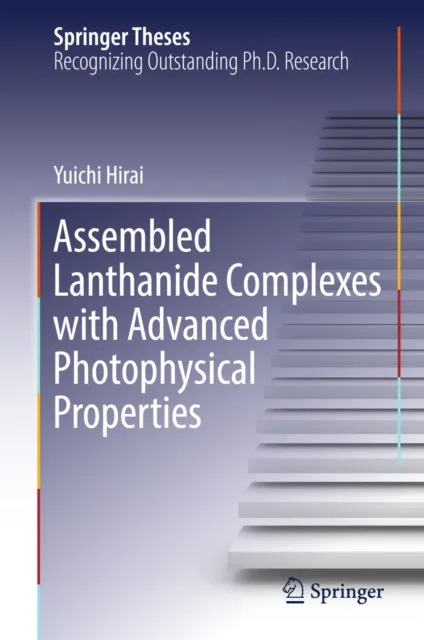
Assembled Lanthanide Complexes with Advanced Photophysical Properties

Introduction
This thesis provides essential information on the systematic design of assembled lanthanide complexes for functional luminescent materials. It discusses the relationships between assembled structures and photo, thermal, and mechanical properties on the basis of crystallography, spectroscopy, and thermodynamics. The described guidelines for assembled structures will be extremely valuable, both for industrial applications and for readers’ fundamental understanding of solid-state photophysics and materials chemistry.
Applications and Challenges
Luminescent lanthanide complexes are promising candidates for lighting devices, lasers, and bio-probes owing to their line-like and long-lived emission arising from characteristic 4f–4f transitions. Low-vibrational and asymmetrical coordination structures around lanthanide ions have been introduced to achieve strong luminescence, using specific organic ligands. Recently, assembled lanthanide complexes including coordination polymers and metal organic frameworks have increasingly attracted attention as a new class of luminescent materials offering thermal stability and color tunability. However, improving the luminescence efficiencies of these compounds remains a challenge, and specific molecular designs to control assembled structures and yield additional physical properties have not been established.
Innovations
The author provides a group of bent-angled bridging ligands to boost photoluminescence efficiency, and successfully introduces for the first time glass formability and strong triboluminescence properties.