£46.99
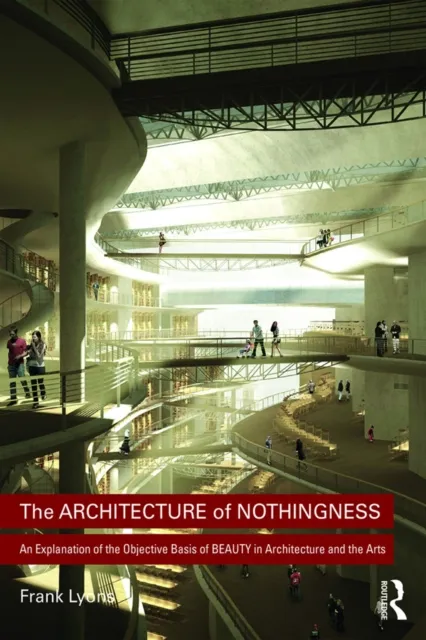
Architecture of Nothingness
An Explanation of the Objective Basis of Beauty in Architecture and the Arts

***Shortlisted for the Architectural Book Awards 2024***
It is a common enough assumption that good buildings make us feel good just as poor ones can make us feel insecure, depressed or even threatened. We may instantly decide that we ‘like’ one building more than another, in the same way that without thinking we choose one work of art or music over another. But what is going on when we make these instant decisions? The process is so complex that it remains an area rarely examined, often considered unfathomable, or for some mysterious, bordering even on the spiritual. Frank Lyons seeks to unpick the complex relationships that go to make up great works of architecture, to reveal a set of principles that are found to apply not only to architecture but also to art, music and culture in general. One of the major complications at the heart of culture is that because the arts are generated subjectively, it is assumed that the finished cultural artefact is also subjective. This is a myth that this book seeks to dispel. The arts are indeed created from the personal subjective space of an individual but what that individual has to say will only be shareable if expressed in coherent (objective) form.
In a nutshell, the book reverses two generally accepted positions, that the arts are subjective and that meaning is objective and therefore shared. The reversal of these seemingly common sense, but mistaken positions enables two important issues to be resolved, firstly it explains how the arts communicate through objectivity and secondly how the meaning of an object of art is never shared but always remains private to the individual. The combination of these two positions ultimately helps us to understand that beauty is a subjective appreciation of an objectively arranged form. Furthermore, this understanding enables the author to explain how a sublimely arranged form can open us to the ineffable; to a field of NOTHINGNESS, or to what some might call the spiritual realm of our own being.